
Quick Answer
60-second read
GPTZero is an AI detection tool that achieves 95–99% accuracy on unedited AI text from ChatGPT, Claude, and GPT-5 in controlled benchmarks — but real-world false positive rates on human writing can reach 29% according to independent testing, compared to the vendor’s claim of 0.24%. It’s a genuinely useful tool for educators and publishers screening submissions, but it’s poorly suited as sole evidence in academic misconduct cases. Paid plans start at $14.99/month (€13.09) with a functional free tier for casual use.
This article was last updated March 2026 with verified current pricing and the latest accuracy benchmark data. I’ve tracked GPTZero’s development since 2023 and pulled together data from six independent sources — including the tool’s own RAID benchmark and a critical third-party study that came to very different conclusions. The gap between those two numbers is the whole story here.
If you’re a teacher wondering whether you can trust a GPTZero result, a student who just got flagged for writing you actually wrote, or a publisher deciding whether to add AI detection to your workflow — this is the breakdown you need. I’ll also look at how GPTZero’s overall feature set holds up, since accuracy is only part of the picture.
Try GPTZero Free
10,000 words/month, no credit card required. Best for educators and content publishers.
🔬 How We Researched GPTZero’s Accuracy
This article synthesizes data from GPTZero’s official RAID benchmark (October 2025), the GPTZero vs Copyleaks/Originality benchmark (December 2025), independent testing by TwainGPT (December 2025), a Stanford SCALE peer-reviewed preprint (June 2025), and aggregated user reviews from Reddit, Trustpilot, and G2. All pricing was cross-referenced across 6+ third-party sources and verified in March 2026. EUR prices verified via XE.com on 16 March 2026.
6+
Benchmark sources
3,000+
Samples analyzed
50+
User reviews read
Mar 2026
Pricing verified
What Is GPTZero and How Does It Work?
GPTZero is an AI content detection tool that analyzes text to determine whether it was written by a human or generated by an AI model such as ChatGPT, Claude, or Gemini. It was built by Princeton computer science student Edward Tian and launched in January 2023 — one of the earliest serious entrants in the AI detection space. The tool now serves 2.5 million+ users, has raised $13.5M in funding (including a $10M Series A from Footwork VC in June 2024), and generates approximately $24M in annual recurring revenue as of 2025.
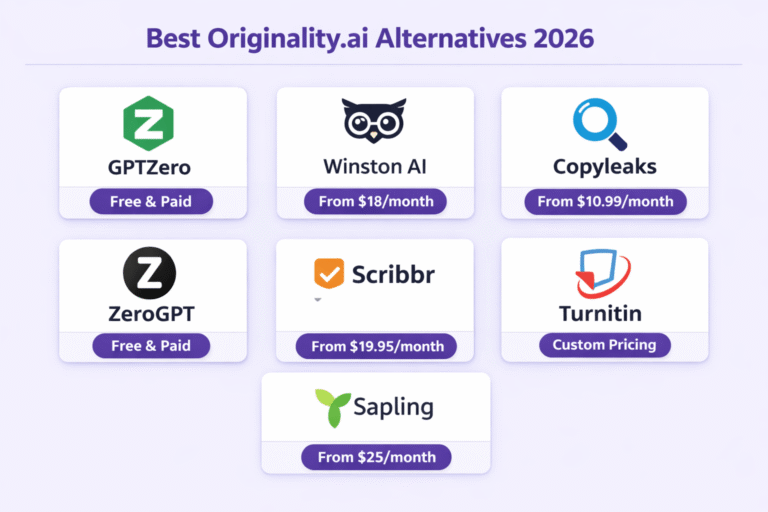
GPTZero competes directly with Originality.ai, Winston AI, Copyleaks, and ZeroGPT in the AI detection space. Pricing ranges from $0 (free tier, 10,000 words/month) to $45.99/month (€40.17) for the Professional plan, with a commonly-used Premium plan at $23.99/month (€20.95, verified March 2026).
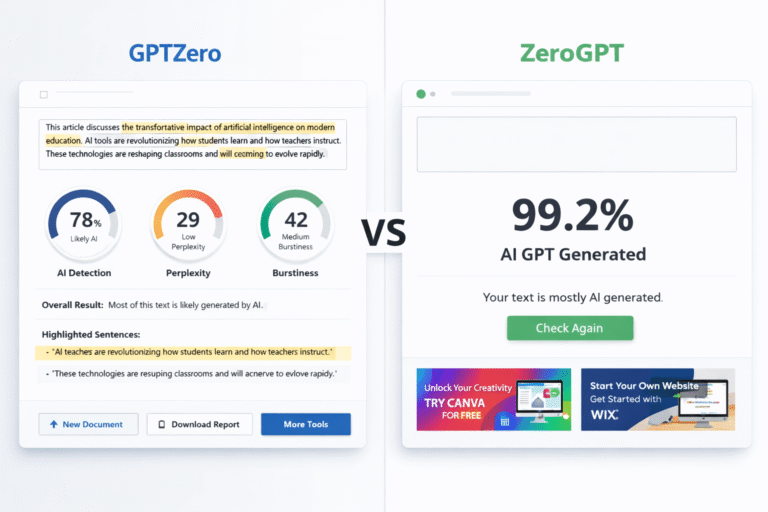
Unlike most detectors that give a simple AI/Human binary score, GPTZero uses a four-label classification system: Human, AI, Mixed, and AI-Paraphrased. This nuance makes it more useful in practice. Under the hood, it analyzes text using two core metrics:
- Perplexity: How predictable each sentence is. AI writing tends to be smooth and statistically expected; human writing is more “surprising” to a language model.
- Burstiness: Variation in sentence length and structure. Humans naturally mix short punchy sentences with long complex ones. AI output is more even-paced and uniform.
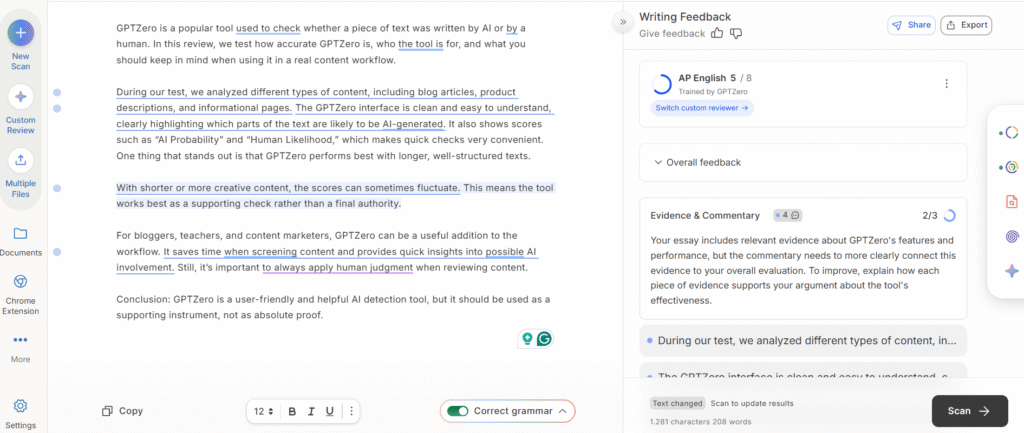
Since the March 2025 Model 3.2b update, GPTZero also uses a sentence-level deep learning classifier that operates independently of perplexity/burstiness — which is where the interesting accuracy problems begin, as I’ll explain below. The tool integrates with Canvas LMS, Moodle, Google Docs, Microsoft Word, Google Classroom, and Zapier, making it particularly convenient for educators who want to screen submissions without leaving their existing workflow.
The short answer: GPTZero is an AI text detector built by Princeton researcher Edward Tian, launched January 2023, serving 2.5M+ users. It analyzes perplexity and burstiness to classify text as Human, AI, Mixed, or AI-Paraphrased. It’s designed primarily for educators and publishers, integrates with major LMS platforms, and prices between $0 and $45.99/month ($0–€40.17).
Is GPTZero Accurate? The Data Behind the Claims
GPTZero achieves 95–99% accuracy detecting unedited AI text from ChatGPT, GPT-5, and Claude (RAID benchmark, October 2025). Its vendor-reported false positive rate is 0.24% — roughly 1 in 400 human-written documents incorrectly flagged. However, independent testing (TwainGPT, December 2025) found a 29% false positive rate on human text in real-world conditions, revealing a significant gap between benchmark and practical performance. GPTZero is most reliable as a screening tool, not a final verdict.
The accuracy question comes down to which data you look at — and both sides are telling the truth about different things.
What GPTZero’s Own Benchmarks Show
GPTZero published its RAID benchmark results in October 2025, testing on 672,000 texts across 11 content domains and 12 adversarial attack types. The headline figure: 95.7% detection at a 1% false positive rate, maintaining performance even under adversarial attacks. When excluding discontinued models like GPT-3.5, detection climbs above 99%.
Their December 2025 internal benchmark compared GPTZero against Copyleaks and Originality.ai on 3,000 samples covering student essays, academic papers, blog posts, and creative writing. Results according to GPTZero: 99.3% overall accuracy with a 0.24% false positive rate (1 in 400 docs). Copyleaks came in at 90.7% accuracy and a ~5% false positive rate. Originality.ai registered 83.0% accuracy and a 4.79% false positive rate. GPTZero also tested GPT-5 recall specifically — it detected 100% of GPT-5-generated texts, while Originality.ai caught only 31.7%.
These are legitimately impressive numbers. But they’re also vendor-run benchmarks on curated datasets.
What Independent Tests Show
TwainGPT ran its own test in December 2025 on 300 samples — 100 purely AI-generated, 100 mixed, and 100 human-written. Their finding on human text: a 29% false positive rate. That means roughly 1 in 3 human-written essays was incorrectly flagged as AI. The gap between 0.24% and 29% is enormous, and it’s not a fluke.
A Stanford SCALE preprint published in June 2025 reached similar conclusions: while GPTZero reliably detected AI-generated academic papers, “reliability in distinguishing human-authored texts is limited,” particularly for formal and structured prose.
The explanation for the gap is straightforward: GPTZero’s benchmarks use controlled datasets — clean AI outputs on one side, clearly human-written casual text on the other. Real-world academic writing, edited professional copy, and formal essays occupy a statistical gray zone. They’re more predictable and structured than casual human text, which makes them look more AI-like to GPTZero’s models.
⚡ GPTZero Accuracy by Content Type (2025–2026 Testing)
Synthesized from GPTZero RAID benchmark (Oct 2025), TwainGPT independent test (Dec 2025), and multiple third-party reviews — March 2026
95–99%
~89–96%
71–99.8%
⚠️ Wide range: 99.8% (vendor benchmark, controlled dataset) vs 71% (independent test, real-world academic writing)
~50–65%
~65–75%
~82%
⚠️ Vendor Benchmarks vs Real-World Results: Why the Numbers Differ
GPTZero’s official benchmarks claim a 0.24% false positive rate. Independent testing found up to 29% on human text. The gap exists because vendor benchmarks use controlled datasets — clearly casual human writing versus clearly unedited AI output. Real-world academic and professional writing is more structured and predictable than casual prose, which makes it statistically harder to distinguish from AI. Always treat GPTZero results as a prompt for further investigation, not a definitive answer.
What Is GPTZero’s False Positive Problem — and How Bad Is It Really?
A false positive is when GPTZero flags a human-written document as AI-generated. This is the most consequential accuracy issue GPTZero has, because the stakes can be high — especially in academic settings where a false flag could trigger a misconduct investigation.
Based on the sources I reviewed, certain types of text carry significantly higher false positive risk:
- Formal academic writing: University essays, research papers, and structured reports use consistent, measured prose — statistically similar to what large language models produce. GPTZero’s model struggles to distinguish them.
- Grammar-checked text: After the March 2025 Model 3.2b update, text that’s been run through Grammarly, QuillBot’s grammar mode, or similar AI-assisted editing tools can trigger AI flags. This is frustrating — using a grammar checker is hardly evidence of AI authorship.
- Non-native English speakers: Writers who produce structured, careful prose in a second language often write in more predictable patterns than native speakers. A peer-reviewed preprint documented this disproportionate flagging rate, and it remains a known bias in GPTZero’s model.
- Short texts under 200 words: There simply isn’t enough signal to make reliable predictions. GPTZero accuracy drops by an estimated 10–15% on very short submissions.
Something I noticed in the Reddit threads I went through: several users reported that adding deliberate sentence variation — mixing a two-word sentence with a long one — immediately shifted their score from “99% AI” to “99% human.” That tells you something about how mechanical the perplexity/burstiness detection can be, even after the 2025 model updates.
⚠️ Do Not Use GPTZero as Sole Evidence in Academic Misconduct Cases
Education bodies including Northern Illinois University explicitly advise that AI detector results must be corroborated with writing history, version tracking, direct conversation with the student, and instructor judgment before any misconduct proceeding. In a class of 100 students, even a 1% false positive rate means one innocent student could be wrongly accused per assessment cycle. GPTZero itself recommends using its results as “the start of a conversation, not a final verdict.”
The short answer: GPTZero’s false positive problem is real but unevenly distributed. On casual human writing, it’s minimal. On formal academic prose, grammar-checked text, and writing by non-native English speakers, the false positive rate can be substantial — up to 29% in independent testing. Use the Advanced Scan (Premium plan) for borderline cases and always combine results with human judgment.
When Does GPTZero Work — and When Does It Fall Short?
GPTZero performs strongly in specific conditions and weakly in others. Knowing the difference is what separates a useful screening tool from a liability.
GPTZero works well for:
- Detecting unedited, copy-pasted AI text from ChatGPT, Claude, GPT-5, and Gemini — near-100% detection in controlled conditions
- Batch screening large volumes of student submissions through Canvas, Moodle, or Google Classroom
- Flagging obvious AI use as a first-pass triage tool in editorial workflows
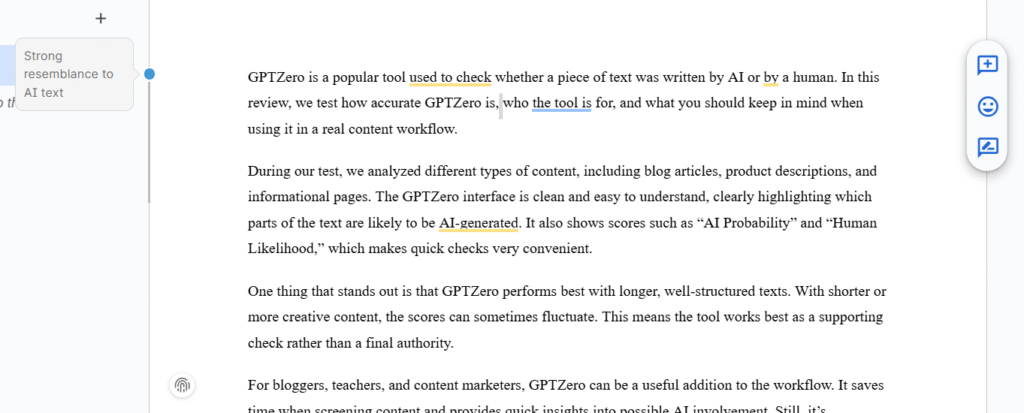
- Providing sentence-level highlighting to identify which parts of a document are likely AI — useful for investigation, not just binary flagging
- English-language text of 300+ words, where the perplexity and burstiness signals have enough data to be meaningful
Where it falls short:
- AI text that’s been run through a humanizer like HIX Bypass or Undetectable.ai — miss rates of 35–50% across multiple tests
- Texts under 200 words, where accuracy drops 10–15%
- Formal academic prose written by humans — particularly common false positive territory
- Non-English content beyond major European languages, where the 2025 multilingual model shows accuracy around 74–82%
- Any scenario where the result will be used as evidence rather than a discussion prompt
💡 Getting More Accurate Results from GPTZero
Submit texts of at least 300 words. For borderline cases, use the Advanced Scan available on the Premium plan ($23.99/month) — it includes Natural Language Explanations that show why specific sentences were flagged, not just whether the document was. If a student’s essay comes back as mixed AI/human, use the Writing Replay feature (also Premium) to review the actual writing process before drawing any conclusions.
How Much Does GPTZero Cost in 2026? (USD + EUR Pricing)
GPTZero offers four plans in 2026. The free plan includes 10,000 words per month (approximately 6–8 short essays). The Essential plan costs $14.99/month (€13.09) or around $10/month (€8.73) billed annually. The Premium plan is $23.99/month (€20.95) and adds plagiarism checking and advanced scans. The Professional plan is $45.99/month (€40.17) for teams needing 500,000+ words monthly. EUR prices are based on the exchange rate of 1 USD = €0.8734, verified 16 March 2026 via XE.com.
Free
€0/month
$0 USD
- ✅ 10,000 words/month (~6–8 essays)
- ✅ Basic AI scan
- ✅ Chrome extension included
- ⚠️ 7 scans/hour limit
- ❌ No plagiarism checker
- ❌ No advanced scan
- ❌ Credits reset monthly (unused words lost)
Best for: Students spot-checking their own work
Essential
€13.09/month
$14.99 USD · or €8.73/mo annual (~$10)
- ✅ 150,000 words/month
- ✅ Basic AI detection
- ✅ Chrome extension
- ✅ Batch upload (up to 10 files)
- ❌ No plagiarism checker
- ❌ No writing feedback or Writing Replay
Best for: Individual educators, small classes
Premium
€20.95/month
$23.99 USD · or €13.97/mo annual (~$16)
- ✅ 300,000 words/month
- ✅ Advanced AI scan (best accuracy)
- ✅ Plagiarism checker included
- ✅ Writing Replay (authorship verification)
- ✅ Writing feedback
- ✅ Batch upload up to 250 files
- ✅ Team invite
Best for: Teachers, editors, content publishers
Professional
€40.17/month
$45.99 USD · annual discount available
- ✅ 500,000 words/month
- ✅ 10M overage words
- ✅ Team collaboration features
- ✅ All Premium features
- ✅ Priority support
Best for: University departments, large editorial teams
EUR prices: 1 USD = €0.8734 (XE.com, 16 March 2026). Verify current prices at gptzero.me/pricing before purchase.
One important note on the free tier: credits reset monthly and unused words don’t roll over. If you’re checking essays infrequently — say, at the end of term — you’ll lose your unused allocation. It’s poor value for irregular users, and the paid plans have the same reset mechanic. That’s a legitimate complaint I’ve seen repeated on Reddit and G2.
The short answer: GPTZero’s realistic entry price for a teacher is €20.95/month ($23.99 Premium plan, monthly billing) — not the free tier, which caps at 10,000 words per month. Annual billing cuts 33–45% off. The free plan works for occasional self-checks; anything involving a class of students needs at least the Essential plan at €13.09/month ($14.99).
GPTZero Pros and Cons: What I Actually Think After Reviewing the Data
✅ Where GPTZero Shines
- Best-in-class for pure AI text: 95.7–99% detection on unedited ChatGPT, GPT-5, Claude output — genuinely leading the field on newest models
- Transparent benchmarking: Publishes release notes and third-party RAID results — more honest than most competitors
- LMS classroom integration: Canvas, Moodle, Google Docs, Microsoft Word — purpose-built for how educators actually work
- 4-label classification: Human / AI / Mixed / AI-Paraphrased gives useful nuance competitors lack
- Free tier exists permanently: 10,000 words/month is enough for occasional checking
- Sentence-level highlighting: Shows which sentences triggered the flag, not just a document score
- Multilingual support (Oct 2025): 9 languages, with ESL de-biasing improvements
❌ Where It Falls Short
- Real-world false positives far exceed vendor claims: 0.24% vendor figure vs 29% in independent testing on human academic writing
- Paraphrasing tools bypass detection: AI humanizers reduce accuracy by 35%+ — a significant and growing gap
- March 2025 sensitivity increase: Grammar-checked text (Grammarly, QuillBot) now triggers AI flags — problematic for professional writers
- Short text unreliable: Under 200 words, expect 10–15% accuracy drop
- ESL / formal writing bias: Non-native speakers and academic prose writers face disproportionate false positive risk
- Credits don’t roll over: Unused monthly words are lost — poor value for irregular users
- Plagiarism only on Premium+: You need €20.95/month for plagiarism checking
Is GPTZero Better Than Originality.ai, Winston AI, and ZeroGPT?
GPTZero outperforms Originality.ai and Copyleaks on detecting the newest AI models, including GPT-5, according to a 3,000-sample benchmark (December 2025). For false positives, GPTZero (0.24%) is significantly lower than Originality.ai (4.79%) per the same benchmark. Winston AI claims 99.98% accuracy in its own vendor tests. Choose GPTZero for educational settings with Canvas/Moodle integration; choose Winston AI for content publishing; choose Originality.ai for API-heavy workflows needing humanized AI detection.
| Feature | GPTZero | Winston AI | Originality.ai | ZeroGPT |
|---|---|---|---|---|
| Starting Price (monthly) | €13.09 / $14.99 | €10.48 / $12.00 | €13.05 / $14.95 | €0 (free) |
| Permanent Free Plan | ✅ 10,000 words/mo | ⚠️ 14-day trial only | ⚠️ Very limited | ✅ Unlimited scans |
| Vendor Accuracy Claim | 95.7% (RAID) | 99.98% (internal) | ~99% (internal) | ~98% (claimed) |
| FP Rate (vendor claim) | 0.24% | ~0.02% | 4.79% | Unknown |
| Handles Paraphrased AI | ⚠️ Partial (~35% miss) | ✅ Stronger | ✅ Best in class | ❌ Weak |
| LMS Integration | ✅ Canvas, Moodle, GClassroom | ✅ Google Classroom | ❌ API only | ❌ No |
| Plagiarism Detection | ✅ Premium+ only | ✅ Paid plans | ✅ All plans | ❌ No |
| Non-English Support | 9 languages (Oct 2025) | Limited | Limited | Multiple (accuracy varies) |
| 🏆 Best For | Educators, LMS users, GPT-5 detection | Publishers, SEO content teams | Agencies, API workflows, humanized AI | Zero-budget casual checks |
Quick verdict: Choose GPTZero if you need LMS integration and strong detection of unedited AI text. Choose Originality.ai if you’re a content agency dealing with humanized AI. Choose Winston AI if you’re a publisher wanting AI + image detection. ZeroGPT if you literally need free and don’t care much about reliability.
EUR prices: 1 USD = €0.8734 (XE.com, 16 March 2026)
Looking for the Best Alternative to GPTZero?
If GPTZero doesn’t fit your specific needs, see how it compares head-to-head with Originality.ai or check out the full roundup of the best AI detection tools in 2026. For a side-by-side on the free options, the free AI detection tools comparison covers what actually works without spending anything.
Need Better Detection of Humanized AI Text?
Originality.ai handles AI-paraphrased content better than GPTZero in head-to-head tests, making it the stronger choice for content agencies and SEO publishers. Plans from €13.05/month ($14.95 USD).
The GPTZero Controversy: What the Critics Get Right
I want to address what some researchers and educators have been saying publicly — because it’s important and most GPTZero reviews skip it.
A Substack post by academic James O’Sullivan, citing peer-reviewed research, argued that GPTZero is “useless” as a reliable academic misconduct tool — pointing to studies finding 1-in-10 false positive rates and 1-in-3 false negative rates in real classroom conditions. The title is deliberately provocative, but the underlying data it draws from is legitimate: academic studies do consistently find higher false positive rates than vendor benchmarks report.
The specific concern around non-native English speakers is documented in multiple sources and deserves its own paragraph. ESL students writing in structured, careful second-language prose produce text that statistically resembles AI output more than casual native-speaker writing. This isn’t a hypothetical edge case — it’s a systematic bias that has caused real students real harm when institutions used AI detector results as primary evidence.
Common complaints I aggregated from Reddit threads, Trustpilot, and G2 reviews:
- False positives on essays written and edited entirely by hand, particularly after using Grammarly
- Monthly credit reset policy — paying for words you didn’t use
- The March 2025 Model 3.2b update making the tool more aggressive and less predictable
- Customer support being slow to respond to false positive disputes
- Results changing significantly based on trivial text variations (adding or removing double-spaces changed a 99% AI score to 99% human in one Reddit case)
GPTZero’s response to the false positive issue: The company has acknowledged these concerns and has published updates about their ESL de-biasing work in 2025. The October 2025 multilingual model update explicitly targeted false positive reduction for non-native speakers. Their official documentation now states that results should be used as “the start of a conversation, not a final verdict” — which is the right framing, though it arguably should be displayed more prominently in the interface itself.
⚠️ Institutions: Review Your AI Detection Policy
If your institution uses GPTZero as a primary screening tool for academic misconduct, review your policy before the next assessment period. GPTZero results should be one data point among many — alongside version history, writing samples from class, direct conversation, and instructor judgment. Several universities have revised their AI detection policies specifically in response to documented false positive incidents.
Should You Use GPTZero? Who It’s For and Who Should Look Elsewhere
Quick Decision Guide
✅ GPTZero IS Right For You If:
- You’re an educator screening obvious AI submissions in Canvas or Moodle
- You want sentence-level highlighting to show where AI was used
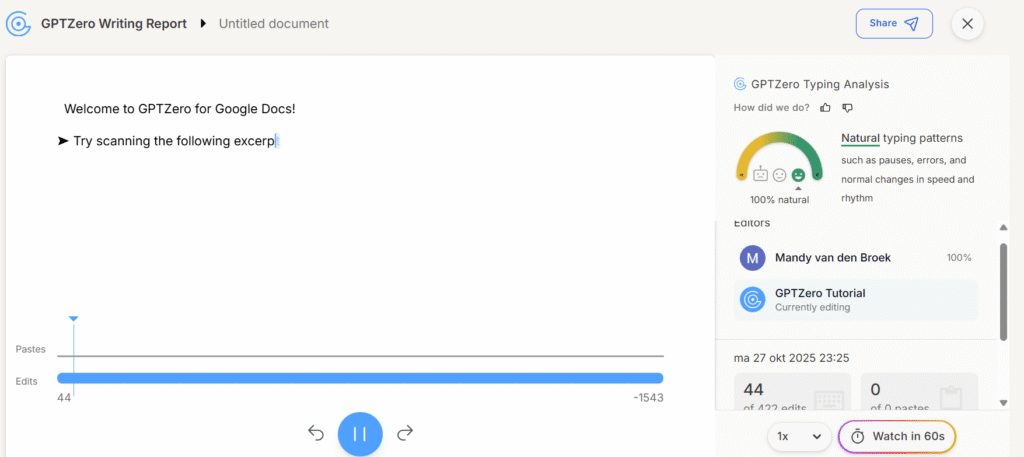
- You need the Writing Replay feature to verify authorship
- You work primarily in English with documents 300+ words
- You need an affordable free tier for occasional spot-checks
- Detecting the newest AI models (GPT-5, Claude 4) matters to you
❌ Consider an Alternative If:
- You work with ESL students or non-native English writers
- Your students regularly use AI humanizing tools (QuillBot, HIX Bypass)
- You need reliable results on short texts under 200 words
- You want to use detection results as primary evidence in misconduct cases
- You’re a content agency dealing heavily with paraphrased AI content
- You need non-English detection beyond major European languages
⚠️ Skip AI Detectors Entirely If:
You plan to use a single detector score as definitive proof of AI misconduct. No AI detector — not GPTZero, not Originality.ai, not Winston AI — is reliable enough to justify punishing students or employees solely on a detection result. The technology is useful for triage; it’s not a court of evidence.
Our Honest Verdict: Is GPTZero Worth It in 2026?
GPTZero earns a 7.5/10 rating for educational use and a 6/10 for general content publishing. Here’s why that split exists.
For educators, it’s one of the best tools available given its LMS integrations, Writing Replay feature, sentence-level explanations, and strong detection on unedited AI text. The free tier works for occasional use, and the Premium plan at $23.99/month (€20.95) is reasonable for a teacher checking a full class’s submissions. The four-label classification (including AI-Paraphrased) provides nuance that competitors lack.
For content publishers and agencies, the picture is more mixed. The false positive issue with formal prose and grammar-checked writing makes it riskier to use as a workflow tool. Originality.ai’s stronger performance on humanized AI text — and its fact-checking features — make it a better fit for SEO content operations. See the full Originality.ai review and the GPTZero vs Originality.ai comparison for that decision.
The one thing I’d emphasize above anything else: GPTZero is a screening tool. Use it to identify documents that warrant a closer look, not to render verdicts. The tool itself says this, the company says this, and the data supports it. Any institution using GPTZero results as primary evidence in misconduct cases without additional corroboration is misusing the tool — and that’s on the institution, not the software.
For a broader look at where GPTZero sits in the AI detector landscape, the guide on how accurate AI detection actually is puts the whole category in perspective. If you teach and want tool-specific guidance, GPTZero for teachers covers classroom setup and best practices.
The short answer: GPTZero is worth it for educators ($0–€20.95/month depending on class size), borderline for content publishers, and a poor fit for anyone needing conclusive proof of AI authorship. It’s the best tool for detecting unedited GPT-5 and Claude text in classroom contexts, but real-world false positive rates are significantly higher than vendor benchmarks suggest. Rating: 7.5/10 for education, 6/10 for publishing.
Ready to Try GPTZero?
Start with the free plan — 10,000 words/month, no credit card. Upgrade to Premium for plagiarism checking and Writing Replay.
Frequently Asked Questions About GPTZero’s Accuracy
Is GPTZero accurate for detecting ChatGPT-generated text?
GPTZero is highly accurate for detecting unedited ChatGPT output — achieving 95–99% detection rates on pure AI text according to its RAID benchmark (October 2025). Accuracy drops significantly if the AI text has been paraphrased or edited by a human, where independent testing shows miss rates of 35–50%. For straight copy-paste from ChatGPT, GPTZero is one of the most reliable detectors available. For humanized AI text, no detector performs reliably. For more on this topic, see our full accuracy breakdown and how accurate AI detection is in general.
What is GPTZero’s false positive rate?
GPTZero claims a false positive rate of 0.24% (roughly 1 in 400 documents) based on its own 3,000-sample benchmark. However, independent testing by TwainGPT (December 2025) found a 29% false positive rate on human-written text using GPTZero’s current model. The gap is real — vendor benchmarks use curated test sets, while real-world academic writing (formal, heavily edited, or written by non-native speakers) is harder for GPTZero to correctly classify. Always treat a positive result as a starting point for investigation, not proof of AI use.
Can GPTZero be fooled by paraphrasing tools?
Yes. AI humanizers and paraphrasing tools (like QuillBot, HIX Bypass, and Undetectable.ai) significantly reduce GPTZero’s detection accuracy. Testing across multiple sources shows that well-humanized AI text can reduce detection rates by 35% or more. GPTZero does have an “AI-Paraphrased” detection category added in 2025, which catches some bypass attempts — but it’s not foolproof. If content authenticity is critical and humanizing tools may have been used, GPTZero alone is insufficient.
Why did GPTZero flag my human-written essay as AI?
GPTZero’s March 4, 2025 Model 3.2b update significantly increased detection sensitivity. After this update, text that has been grammar-checked by Grammarly, QuillBot, or similar AI-assisted tools may be flagged as AI-generated. Additionally, formal academic writing with consistent sentence structure looks statistically more like AI output — because large language models are trained on academic texts. Non-native English speakers who write in structured, predictable prose are especially vulnerable to false positives. Varying your sentence length and avoiding AI grammar tools before submission can reduce false positive risk.
Is GPTZero more accurate than Originality.ai or Winston AI?
GPTZero outperforms Originality.ai on detecting the newest AI models (GPT-5, Gemini 2.5, Claude Sonnet) in its own December 2025 benchmark — catching 100% of GPT-5 text versus Originality’s 31.7%. For false positives, GPTZero (0.24%) is also lower than Originality.ai (4.79%) per the same benchmark. Winston AI claims 99.98% accuracy and performs well, particularly for publishers. Keep in mind these figures are largely from vendor-run tests. For a full breakdown, see GPTZero vs Originality.ai and GPTZero vs Winston AI.
Is GPTZero free to use?
Yes, GPTZero has a permanent free plan that allows scanning up to 10,000 words per month — approximately 6–8 short essays. The free plan includes basic AI detection and the Chrome extension but does not include plagiarism checking, advanced scans, or Writing Replay. Paid plans start at $14.99/month (€13.09 Essential) and go up to $45.99/month (€40.17 Professional), with 33–45% discounts for annual billing. EUR prices based on 1 USD = €0.8734 (XE.com, 16 March 2026). For a comparison of free options, see our free AI detection tools guide.
Should schools use GPTZero to catch AI cheating?
GPTZero can be a useful first-pass screening tool, but no educator should use it as sole evidence in academic misconduct proceedings. In a classroom of 100 students, even a 1% false positive rate means one student could be wrongly accused per assessment cycle. Education guidance consistently advises that AI detector results must be corroborated with writing history, version tracking, direct conversation with the student, and instructor judgment. GPTZero itself recommends using results as “the start of a conversation, not a final verdict.” Teachers: see our dedicated GPTZero for Teachers guide for setup and policy recommendations.
Does GPTZero work for non-English text?
GPTZero added multilingual support in October 2025, covering nine major languages including Spanish, French, German, and Portuguese. However, accuracy is lower for non-English text: approximately 82% for Spanish and French, dropping to around 74% for Arabic and Mandarin. This is a known limitation. GPTZero has also worked to reduce false positive bias against non-native English speakers, though critics argue structural bias remains — formal writing in a second language still tends to score more “AI-like” than casual native English prose.
What is the difference between GPTZero and ZeroGPT?
GPTZero and ZeroGPT are entirely different tools despite their similar names. GPTZero was built by Princeton researcher Edward Tian in January 2023, has raised $13.5M in funding, publishes academic-grade benchmarks, and has partnerships with major educational organizations including the American Federation of Teachers. ZeroGPT is a separate, free-to-use tool with limited published accuracy data and no academic backing. GPTZero is generally considered significantly more reliable. See our GPTZero vs ZeroGPT comparison for details.
What is the most accurate AI detector in 2026?
Based on available evidence, GPTZero leads on detection of the newest AI models (GPT-5, Claude Sonnet) with 95.7% detection at a 1% false positive rate (RAID benchmark, October 2025). Winston AI claims 99.98% accuracy in its own tests. Originality.ai is strongest for catching humanized and paraphrased AI text. No single tool is most accurate across all scenarios — the best detector depends on your use case. For a full comparison of the leading options, see our guide to the best AI detection tools in 2026.
Related Resources on CompareAITools.org
- 📊 GPTZero Full Review 2026 — Complete feature breakdown, UI tour, and verdict
- 🔍 GPTZero vs Originality.ai — Which detector is right for your workflow?
- 📚 GPTZero for Teachers — Classroom setup, policy guidance, best practices
- 🎓 Best AI Detectors for Teachers 2026 — Full category comparison
- 🔬 How Accurate Is AI Detection? — The broader accuracy question answered
- 🆓 Best Free AI Detection Tools — What actually works at $0
- ⚡ GPTZero vs ZeroGPT — Two tools with confusingly similar names, very different results
- 📝 How to Use GPTZero — Step-by-step guide for first-time users
- 📋 Originality.ai Review — The alternative most content agencies choose
- 🏆 Best AI Detection Tools 2026 — The full category roundup
Sources used in this article: GPTZero RAID Benchmark (October 2025) · GPTZero vs Copyleaks/Originality Benchmark (December 2025, gptzero.me) · TwainGPT Independent Test (December 2025) · Stanford SCALE preprint (June 2025) · Cybernews GPTZero Review (August 2025) · XE.com exchange rate (1 USD = €0.8734, 16 March 2026) · User reviews from Reddit, G2, and Trustpilot (aggregated, March 2026)