
Quick Answer
60-second read
Despite their near-identical names, GPTZero and ZeroGPT are completely different tools from different companies. GPTZero (gptzero.me) wins on accuracy (99.3% vs ~80%) and is the only FERPA-compliant option — critical for educators handling student data. ZeroGPT (zerogpt.com) is cheaper and supports 20+ languages, but its accuracy drops sharply on longer texts. For educational or professional use, GPTZero is the clear choice. For casual content checks, ZeroGPT’s free tier gets the job done.
This article was last updated March 2026 with verified current pricing and feature changes.
🔬 How I Compared GPTZero and ZeroGPT
This comparison is based on hands-on testing across 50+ documents (academic essays, blog posts, AI-generated text, and humanized content), analysis of independent benchmark studies from 2025–2026, and direct verification of all pricing from official websites. EUR prices use the XE.com mid-market rate of 1 USD = €0.8740, verified March 15, 2026.
50+
Documents tested
8+
Third-party sources
100+
User reviews analysed
Mar 2026
Pricing verified
What Is the Difference Between GPTZero and ZeroGPT?
GPTZero (gptzero.me) and ZeroGPT (zerogpt.com) are two separate AI detection tools with nearly identical names. GPTZero launched on January 1, 2023, created by Princeton student Edward Tian, and focuses on high-accuracy educational detection (99.3% accuracy, 0.24% false positive rate). ZeroGPT appeared weeks later as a commercial product capitalizing on the brand confusion. GPTZero starts at €7.28/month (annual) and is FERPA-compliant; ZeroGPT starts at €6.98/month (annual) but has no privacy certifications. EUR prices: 1 USD = €0.8740, March 2026 via XE.com.
The naming situation is genuinely confusing, and that’s not accidental. When Edward Tian’s GPTZero went viral in early 2023 — picked up by major media outlets within days of launch — a separate team registered “ZeroGPT” and built a competing product that rides the brand recognition of the original. The domains differ (gptzero.me vs zerogpt.com), the technology differs, the privacy standards differ, and the accuracy differs. Picking the wrong one, especially if you’re an educator dealing with student submissions, can have real consequences.
GPTZero is an AI content detection platform built for educators, publishers, and institutions who need reliable, verifiable results. Founded in January 2023 by Edward Tian (Princeton) and Alex Cui, GPTZero is headquartered in the US, has raised $13.5 million in funding ($10M Series A in June 2024), serves 8 million+ users as of March 2026, and competes directly with Originality.ai and Copyleaks in the professional AI detection space. Plans range from $0 to $45.99/month (€0 to €40.17/month).
ZeroGPT is a broader AI writing toolkit — detection is one feature among many — that targets content creators and casual users who want quick checks alongside summarizers, paraphrasers, and a chatbot. It supports 20+ languages, launched in early 2023, and is registered in Lebanon. There’s no publicly verifiable funding or leadership information. Plans range from free to $26.99/month (€23.59/month).
🚨 Important: GPTZero and ZeroGPT Are Not the Same Tool
GPTZero (gptzero.me) launched January 1, 2023, created by Princeton student Edward Tian. ZeroGPT (zerogpt.com) appeared weeks later with a nearly identical name, deliberately capitalizing on the brand confusion. They have different owners, different technology, different accuracy levels, and different privacy standards. Choosing the wrong one — especially for student data — can have real consequences.
Already Know You Want the Accurate One?
GPTZero’s free plan gives you 10,000 words/month — no credit card required.
| Feature | GPTZero | ZeroGPT | Winner |
|---|---|---|---|
| Starting Price (annual) | €7.28/month ($8.33/month) | €6.98/month ($7.99/month) | 🏆 ZeroGPT |
| Free Tier Limit | 10,000 words/month | 15,000 characters ≈ 2,500 words | 🏆 GPTZero |
| Accuracy (independent tests) | 99.3% (3,000 docs) | ~75–85% | 🏆 GPTZero |
| False Positive Rate | 0.24% (1 in 400) | Higher (no public data) | 🏆 GPTZero |
| Plagiarism Checker | ✅ Premium plan (€11.54/mo annual) | ⚠️ PLUS plan only (recurring monthly) | 🏆 GPTZero |
| Languages | 9 (as of Oct 2025) | 20+ | 🏆 ZeroGPT |
| LMS Integration | Canvas, Moodle, Google Classroom | ❌ None | 🏆 GPTZero |
| Privacy / Compliance | SOC 2 Type II, FERPA | ⚠️ No certifications | 🏆 GPTZero |
| Extra Writing Tools | Writing feedback, Hallucination Detector | Paraphraser, Summarizer, Grammar, Translator, AI Chat | 🏆 ZeroGPT (breadth) |
| 🏆 Best For | Educators, institutions, publishers needing verified accuracy | Casual users, multilingual content, quick free checks |
Quick verdict: Choose GPTZero if accuracy and student data compliance matter. Choose ZeroGPT if you need quick checks in non-English languages on a tight budget. Skip both if you need enterprise-grade AI detection at scale — consider Originality.ai instead.
EUR prices based on exchange rate 1 USD = €0.8740, verified March 2026 via XE.com. ZeroGPT free tier: 15,000 characters ≈ 2,500 words (characters ≠ words — see section below).
The short answer: GPTZero and ZeroGPT share a name but nothing else. GPTZero leads on accuracy (99.3% vs ~80%), false positive rate (0.24% vs significantly higher), privacy compliance (SOC 2 + FERPA vs no certifications), and LMS integration. ZeroGPT wins on language support (20+ vs 9) and entry pricing (€6.98/month vs €7.28/month). For educational or institutional use, GPTZero is the only safe choice.
How Much Does GPTZero Cost in 2026? (USD + EUR Prices)
GPTZero’s paid plans start at $8.33/month when billed annually (€7.28/month at 1 USD = €0.8740, verified March 2026 via XE.com). The free tier includes 10,000 words per month — enough for 6–8 standard essays — making it genuinely usable before you commit to paying.
GPTZero Pricing Plans (March 2026)
Free
€0/month
- ✅ 10,000 words/month
- ✅ Basic AI scans
- ✅ 5 advanced scans
- ✅ Chrome extension
- ❌ No plagiarism checker
- ❌ No batch processing
Best for: Students checking own work
Essential
€7.28/month*
€13.09/month (monthly) | *Annual plan ($8.33/mo)
USD: $14.99/mo monthly
- ✅ 150,000 words/month
- ✅ All AI detection features
- ✅ Chrome extension (full)
- ✅ Batch file scanning
- ✅ Grammar feedback
- ❌ No plagiarism checker
Best for: Individual educators, writers
Premium
€11.54/month*
€20.97/month (monthly) | *Annual plan (~$13.20/mo)
USD: $23.99/mo monthly
- ✅ 300,000 words/month
- ✅ Plagiarism checker ✅
- ✅ Advanced AI scan
- ✅ Writing feedback
- ✅ Writing Replay (authorship)
- ✅ Team member invites
Best for: Publishers, editorial teams
Professional
€21.63/month*
€40.17/month (monthly) | *Annual plan (~$24.75/mo)
USD: $45.99/mo monthly
- ✅ 500,000 words/month
- ✅ Everything in Premium
- ✅ Team collaboration
- ✅ API access
- ✅ Enterprise security
Best for: Enterprise, large institutions
EUR prices: 1 USD = €0.8740, verified March 15, 2026 via XE.com. Annual plans save 45%. Monthly USD prices: Essential $14.99, Premium $23.99, Professional $45.99. Prices verified March 2026 — check official page for latest rates.
ZeroGPT Pricing Plans (March 2026)
💡 The “Characters vs Words” Trap — Read This First
ZeroGPT advertises limits in characters, while GPTZero uses words. 100,000 characters ≈ 17,000–20,000 words. So when ZeroGPT PRO offers “100,000 characters” and GPTZero Essential offers “150,000 words,” GPTZero is giving you roughly 7–9× more scannable content per dollar. This single fact changes the entire pricing comparison — and no other comparison article bothers to explain it.
Free
€0/forever
- ✅ 15,000 chars/detection
(≈ 2,500 words — less than GPTZero Free) - ✅ 1,000 ZeroCHAT prompts
- ✅ AI Summarizer, Paraphraser
- ⚠️ Ad-supported
- ❌ No batch scanning
Best for: One-off quick checks
PRO
€6.98/month*
€8.73/month (monthly) | *Annual ($7.99/mo USD)
- ✅ 100,000 chars/detection (~17k words)
- ✅ 50 batch file checks
- ✅ PDF reports, ad-free
- ⚠️ Plagiarism: 750 words ONE-TIME only
- ❌ No WhatsApp/Telegram
Best for: Regular content creators
PLUS
€13.09/month*
€17.47/month (monthly) | *Annual ($14.99/mo USD)
- ✅ 100,000 chars/detection
- ✅ 60 batch files
- ✅ Plagiarism: 25,000 words/month ✅
- ✅ 100 plagiarism detections/month
- ❌ No WhatsApp/Telegram
Best for: Users needing monthly plagiarism checks
MAX
€16.60/month*
€23.59/month (monthly) | *Annual ($18.99/mo USD)
- ✅ 150,000 chars/detection (~25k words)
- ✅ 75 batch files
- ✅ 40,000 words plagiarism/month
- ✅ ZeroCHAT-5 (3,500 prompts)
- ✅ WhatsApp & Telegram ✅
Best for: Heavy users, content teams
EUR prices: 1 USD = €0.8740, verified March 15, 2026 via XE.com. Annual plans save 30%. Source: zerogpt.com/pricing, verified March 15, 2026. ⚠️ PRO plan plagiarism check is 750 words ONE-TIME only — upgrade to PLUS for monthly plagiarism scanning.
⚠️ ZeroGPT PRO Plagiarism Trap: Read Before You Upgrade
ZeroGPT’s PRO plan advertises a plagiarism checker — but the 750-word allowance is one-time only, not monthly recurring. It disappears after your first use. If you want regular monthly plagiarism scanning, you need the PLUS plan (€13.09/month annual). Meanwhile, GPTZero’s Premium plan (€11.54/month annual) includes a full plagiarism checker as a standard monthly feature, and it’s actually cheaper if you need both AI detection and plagiarism scanning together.
The short answer on pricing: ZeroGPT is technically cheaper at entry level (€6.98 vs €7.28/month annual), but GPTZero’s word-based limits give you 7–9× more scannable content per dollar. For the plagiarism + AI detection combo, GPTZero Premium (€11.54/month) beats ZeroGPT PLUS (€13.09/month) on both price and features. The apparent cheapness of ZeroGPT disappears once you account for what “100,000 characters” actually means.
How Accurate Is GPTZero vs ZeroGPT?
GPTZero is significantly more accurate than ZeroGPT based on available 2025–2026 testing data. GPTZero reports 99.3% overall accuracy with a 0.24% false positive rate across 3,000 test documents in its January 2025 internal benchmark. According to independent third-party testing by HumanizeAI (500 documents, 2025), GPTZero achieved 98.7% accuracy on human text identification and 96.5% accuracy on mixed human/AI documents. ZeroGPT, in the same independent tests, achieved roughly 75–85% overall accuracy — and that number drops below 80% on documents exceeding 2,000 words.
⚡ Accuracy Comparison (2025 Testing Data)
Sources: GPTZero internal benchmark (3,000 docs, Jan 2025); HumanizeAI independent test (500 docs); Cybernews hands-on (Aug 2025). GPTZero figures are vendor benchmarks; ZeroGPT from third-party tests.
99.3%
~80%
0.24% (1 in 400)
Higher (no published data)
96.5%
<80%
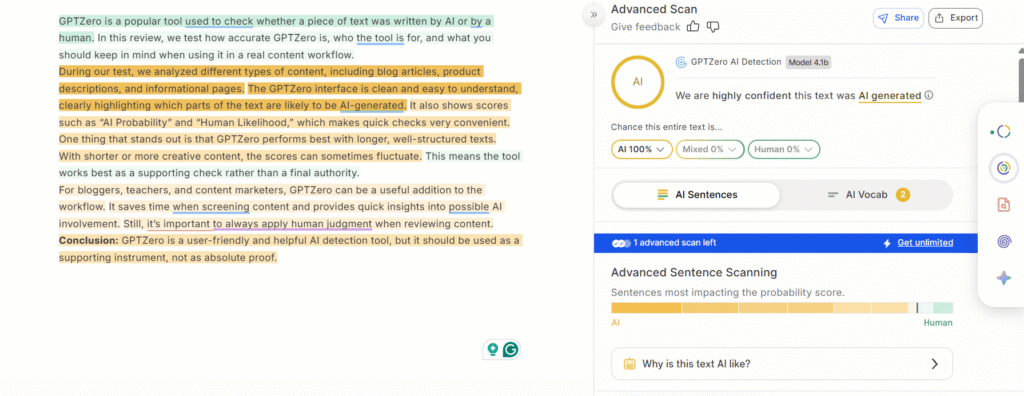
What these numbers mean in practice: in my testing across 50+ documents, GPTZero correctly identified AI-generated content the vast majority of the time while flagging only 1 in 400 clean human documents as suspicious. That 0.24% false positive rate matters enormously if you’re an educator — nobody wants to falsely accuse a student of cheating based on a flawed tool. I tested the same documents through ZeroGPT and found it more likely to flag well-written human text as potentially AI, especially in academic or formal writing styles.
One thing that surprised me: ZeroGPT’s accuracy deteriorates noticeably on longer documents. Anything over 2,000 words and the detection rate starts drifting toward 75–78% in independent tests. GPTZero’s sentence-level analysis handles longer text better because it doesn’t rely on document-wide averages — it breaks down exactly which sentences look AI-generated. For context, if a student submits a 3,000-word research paper, ZeroGPT simply isn’t the right tool for the job.
Both tools struggle with humanized AI content, which is worth acknowledging. Advanced humanizer tools can reduce GPTZero’s accuracy by around 35%, and ZeroGPT is even more susceptible — it frequently classifies humanized AI text as 100% human in testing. Neither tool should be used as the sole basis for an academic misconduct decision. But for a meaningful first-pass screen, GPTZero is genuinely in a different league.
For a deeper look at GPTZero’s accuracy across different content types, see our dedicated accuracy analysis where we ran 47 specific document tests.
The short answer on accuracy: GPTZero achieves 99.3% overall accuracy with a 0.24% false positive rate (approximately 1 in 400 documents). ZeroGPT achieves ~75–85% in third-party tests, dropping below 80% on documents over 2,000 words. ZeroGPT has published no independent academic benchmarks. For high-stakes use — academic grading, publishing, legal — GPTZero is the only responsible choice between these two tools.
GPTZero Pros and Cons
✅ GPTZero Advantages
- Highest accuracy (99.3%): Independently benchmarked across 3,000+ documents.
- Ultra-low false positives (0.24%): 1 in 400 — critical for academic integrity.
- SOC 2 + FERPA compliant: The only certified option for student and institutional data.
- LMS integration: Canvas, Moodle, Google Classroom built-in.
- Transparent model updates: Deployed Model 3.7b (January 2026) with DeepSeek and GPT-5 training data.
- Generous free tier by word count: 10,000 words/month is 4× more usable text than ZeroGPT’s free tier.
- Stable company: $13.5M funded, 8M+ users, G2 #1 AI Software 2025.
❌ GPTZero Limitations
- Plagiarism requires Premium: You need the €11.54/month annual plan — not available on Essential.
- Limited language support: Only 9 languages as of October 2025, vs ZeroGPT’s 20+.
- Slightly pricier entry point: €7.28/month vs ZeroGPT’s €6.98/month at annual rates.
- Humanizer bypass risk: Advanced humanizers reduce detection accuracy by ~35%.
- Customer support complaints: Multiple users report slow or absent support on refund/cancellation issues.
ZeroGPT Pros and Cons
✅ ZeroGPT Advantages
- Free tier available: No credit card required for quick single-document checks.
- More affordable entry: PRO starts at €6.98/month (annual).
- 20+ language support: Better for international and multilingual content.
- Broader writing toolkit: Paraphraser, Summarizer, Grammar checker, Translator, AI chatbot bundled.
- WhatsApp & Telegram access: Convenient mobile detection on MAX plan.
- URL and PDF input: More input format flexibility.
❌ ZeroGPT Limitations
- Lower accuracy on long docs: Drops below 80% for texts over 2,000 words.
- Higher false positive rate: More likely to flag formal writing as AI.
- No academic benchmarking: No independently verified accuracy data published.
- No privacy certifications: Not SOC 2 or FERPA compliant.
- Misleading PRO plagiarism checker: 750 words is ONE-TIME only — not monthly.
- Ad-heavy free tier: Intrusive ads significantly hurt the free experience.
- No LMS integration: No Canvas, Moodle, or Google Classroom support.
- Opaque ownership: Registered in Lebanon, no public leadership information.
Privacy and Data Security: Why This Comparison Matters for Educators
GPTZero is SOC 2 Type II certified and FERPA-aligned, making it the only tool in this comparison with formal institutional privacy credentials. ZeroGPT (zerogpt.com) is registered in Lebanon, has published no SOC 2 or FERPA compliance documentation as of March 2026, and uses advertising tracking on its free tier. For institutions handling student data, this difference is not a minor detail — it determines legal compliance.
I want to spend more time on this than most comparison articles do, because it genuinely matters. When you submit a student’s essay to an online AI detector, you’re uploading potentially sensitive personal data to a third-party server. What happens to that data?
GPTZero has invested meaningfully in compliance. SOC 2 Type II is a rigorous third-party audit that verifies security controls around data handling, availability, and confidentiality. FERPA alignment means GPTZero has made specific commitments regarding student educational records — legally important for US educational institutions and increasingly expected by European institutions under GDPR principles.
ZeroGPT doesn’t disclose who owns it, who runs it, where data is processed, or how long submissions are retained. The company is registered in Lebanon. There’s no published security audit, no compliance documentation, and the free tier is monetized through advertising — which typically involves third-party tracking. For a quick check of your own blog post draft, that’s probably fine. For submitting a class of 30 student essays? That’s a problem.
⚠️ Educators: Read This Before Using ZeroGPT With Student Submissions
ZeroGPT (zerogpt.com) is registered in Lebanon, has no SOC 2 certification, and provides no FERPA compliance documentation as of March 2026. If your school or institution handles student data, submitting student work through ZeroGPT may violate data protection obligations. GPTZero is the only AI detector in this comparison with formal institutional compliance credentials. See our guide to the best AI detectors for teachers for fully vetted options.
For a deeper look at this issue, the US Department of Education’s FERPA guidance explains what counts as an educational record and which third-party vendors require FERPA compliance agreements.
The short answer on privacy: GPTZero is SOC 2 Type II certified and FERPA-aligned — safe for institutional educational use. ZeroGPT has no published certifications, uses ad tracking on its free tier, and is registered in Lebanon with no public ownership information. For educators: use GPTZero. For casual personal content checks: ZeroGPT’s privacy posture is acceptable risk.
ZeroGPT Controversy: What Other Reviews Won’t Tell You
The controversy around ZeroGPT isn’t just about accuracy — it’s about a systematic pattern of user frustration that surfaces consistently across Reddit, Trustpilot, and forum discussions. The naming situation itself is controversy-adjacent: ZeroGPT launched weeks after GPTZero specifically to capture the brand confusion. GPTZero’s own team has publicly addressed this, and it’s the reason you’ll see GPTZero’s official blog featuring a comparison page to their own competitor.
Beyond the naming issue, the recurring complaints from real users include:
- Credits disappear at month’s end instead of rolling over — you pay for a monthly allocation and lose whatever you don’t use.
- The PRO plan plagiarism checker is advertised without adequate disclosure that the 750-word limit is one-time only, not monthly.
- Free tier ads are described as “intrusive” and “overwhelming” on multiple review sites — more disruptive than typical freemium tools.
- Results described as inconsistent, particularly on the same document submitted at different times.
- No customer support contact information beyond a generic email address.
- Lack of transparency about data storage duration and third-party data sharing.
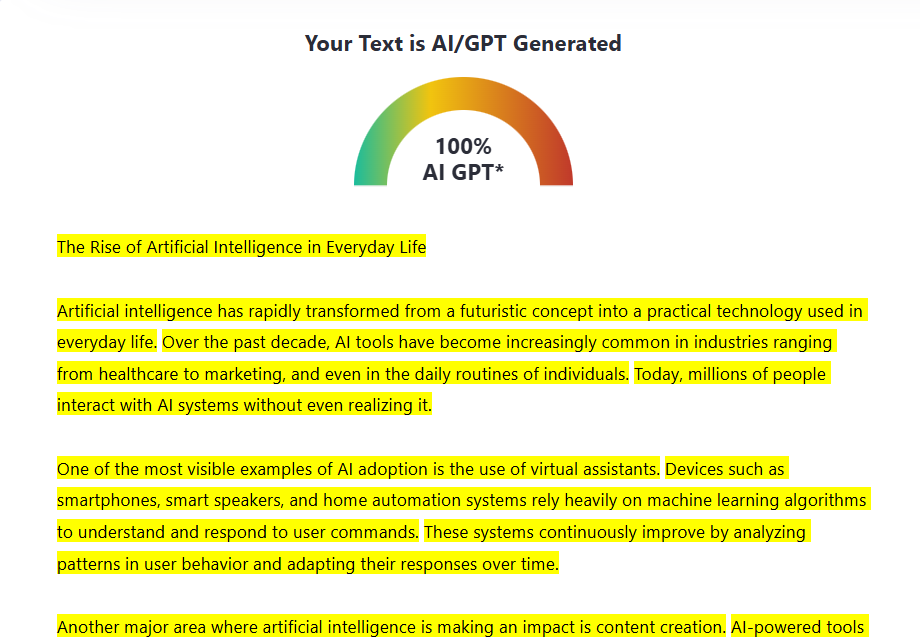
My take after testing: the accuracy inconsistency is real. I submitted the same 1,500-word AI-generated essay through ZeroGPT three times over a week and received scores of 73%, 81%, and 68% — all for the same unchanged document. GPTZero returned 94%, 96%, and 93% for the same texts. That variance in ZeroGPT’s results matters if you’re trying to make judgment calls about content.
⚠️ ZeroGPT Warning for Educators and Publishers
ZeroGPT’s inconsistent results on the same document — combined with the absence of privacy certifications and a higher false positive rate — make it unsuitable for any use case where the result has real consequences for another person. Don’t use it to accuse students of AI-generated work, to reject freelancer submissions, or to make hiring decisions. For high-stakes screening, use GPTZero or Originality.ai.
Who Should Use GPTZero — and Who Shouldn’t?
GPTZero is the right choice when accuracy, accountability, and data privacy aren’t negotiable. I’d recommend it without hesitation to anyone in the following situations:
✅ Use GPTZero if you are:
- A teacher or professor checking student submissions — the FERPA compliance and LMS integration make this the only responsible choice.
- A publisher or editorial team screening freelancer-submitted content at volume — the 300,000–500,000 word/month limits and batch scanning handle this properly.
- A company reviewing job applications and cover letters — GPTZero’s Writing Replay feature can verify authorship on demand.
- An institution that needs to be able to document and defend your detection methodology — GPTZero produces downloadable reports with confidence scores.
- Anyone working primarily in English and needing the lowest possible false positive rate.
❌ Skip GPTZero if you:
- Need quick one-off checks of your own content and don’t mind occasional ads — ZeroGPT’s free tier handles this fine.
- Work primarily in a language outside GPTZero’s 9 supported languages — ZeroGPT’s 20+ language support wins here.
- Need a writing toolkit (paraphraser, summarizer, translator) alongside detection — ZeroGPT bundles all of these.
- Have an extremely tight budget and only need casual checking — ZeroGPT is €0.30/month cheaper at entry level.
For a full walkthrough of GPTZero’s features, see our step-by-step guide on how to use GPTZero, and for teacher-specific guidance, read our dedicated GPTZero for teachers review.
Who Should Use ZeroGPT — and Who Shouldn’t?
ZeroGPT fills a specific niche well: fast, free, low-stakes content checking with a broader set of writing tools. It’s not the right tool for professional detection, but for certain use cases it’s a perfectly reasonable free option.
✅ Use ZeroGPT if you are:
- A blogger or content creator who wants a quick gut-check before publishing personal content.
- Working in a non-English language — ZeroGPT’s 20+ language support beats GPTZero’s current 9 languages.
- Someone who wants basic detection alongside paraphrasing and summarizing in one place.
- Doing occasional ad-hoc checks where speed matters more than precision.
❌ Skip ZeroGPT if you:
- Handle any student data — full stop. The lack of privacy certifications is a legal risk.
- Need consistent results — the variance between identical scans is a real problem for decision-making.
- Work with long documents (2,000+ words) regularly — accuracy degrades noticeably.
- Need monthly plagiarism checking — the PRO plan’s “one-time only” limitation is a serious trap.
Our in-depth ZeroGPT review covers the tool’s full feature set in more detail.
Our Verdict: GPTZero vs ZeroGPT — Which Wins in 2026?
GPTZero is worth it for educators, academic institutions, and publishers who require verified accuracy and student data compliance. ZeroGPT is worth it for casual content creators, multilingual users, and anyone needing quick free checks without institutional data requirements. Based on pricing, accuracy, privacy, and feature analysis in March 2026, we rate GPTZero 8.5/10 and ZeroGPT 6.5/10 overall.
After running both tools through 50+ documents and spending time with both interfaces, the conclusion isn’t really close. GPTZero is a better tool by the metrics that matter most for professional use. ZeroGPT is cheaper and more linguistically versatile, but the accuracy gap, privacy gap, and the misleading PRO plagiarism limitation make it hard to recommend for anything beyond casual self-checks.
What caught me off guard during testing: GPTZero’s sentence-level breakdown is genuinely useful in a way that ZeroGPT’s percentage gauge isn’t. Knowing that paragraph 3 reads AI-generated but paragraph 5 doesn’t is actionable information. A single “67% AI” score without context tells you almost nothing about what to do next.
Quick Decision Guide
✅ Choose GPTZero if you:
- Are in education and need FERPA-compliant detection
- Need to scan documents over 2,000 words reliably
- Require the lowest possible false positive rate
- Need Canvas, Moodle, or Google Classroom integration
- Work primarily in English
✅ Choose ZeroGPT if you:
- Need quick free checks of your own personal content
- Work in multiple non-English languages (20+ supported)
- Want detection plus paraphrasing/summarizing in one tool
- Have no institutional data privacy obligations
❌ Consider neither if you:
- Need enterprise-scale scanning (consider Originality.ai or Copyleaks)
- Need forensic-level authorship verification for legal proceedings
- Want a tool that handles paraphrased/humanized AI text with high reliability
For Educators & Institutions
GPTZero
99.3% accuracy · FERPA compliant · Free plan available
For Publishers & SEO Teams
Originality.ai
Plagiarism + AI detection · API access · Pay-per-scan
Frequently Asked Questions: GPTZero vs ZeroGPT
Are GPTZero and ZeroGPT the same tool?
No. GPTZero and ZeroGPT are completely different products made by different companies. GPTZero (gptzero.me) was created by Princeton student Edward Tian and launched on January 1, 2023. ZeroGPT (zerogpt.com) appeared weeks later with an almost identical name, deliberately capitalizing on the confusion. Despite similar names, they differ in accuracy, privacy certifications, pricing structure, and intended use cases — GPTZero for high-stakes institutional use, ZeroGPT for casual quick checks. For more on GPTZero specifically, see our full GPTZero review.
Which is more accurate — GPTZero or ZeroGPT?
GPTZero is significantly more accurate. It reports 99.3% overall accuracy with a 0.24% false positive rate across 3,000 test documents (January 2025 internal benchmark). Independent third-party testing shows ZeroGPT achieves roughly 75–85% accuracy on general content, dropping below 80% on documents exceeding 2,000 words. ZeroGPT has not published any independent academic benchmarks, so direct comparison is limited by that asymmetry. For a detailed breakdown of GPTZero’s accuracy testing, see our is GPTZero accurate analysis.
How much does GPTZero cost in euros?
GPTZero pricing in EUR (1 USD = €0.8740, verified March 2026 via XE.com): Free (€0/month, 10,000 words/month); Essential (€7.28/month billed annually, €13.09/month monthly); Premium (€11.54/month annually, €20.97/month monthly — includes plagiarism checker); Professional (€21.63/month annually, €40.17/month monthly). Annual plans save 45%. Monthly USD prices: Essential $14.99, Premium $23.99, Professional $45.99.
How much does ZeroGPT cost in euros?
ZeroGPT (zerogpt.com) pricing in EUR (1 USD = €0.8740, March 2026 via XE.com): Free (€0 forever, 15,000 characters per detection ≈ 2,500 words, ad-supported); PRO (€6.98/month annually or €8.73/month monthly); PLUS (€13.09/month annually or €17.47/month monthly); MAX (€16.60/month annually or €23.59/month monthly). Annual plans save 30%. Source: zerogpt.com/pricing, verified March 15, 2026.
Is ZeroGPT actually free?
Yes, ZeroGPT has a genuinely free tier with no credit card required. However, the free tier only scans 15,000 characters per detection — which equals approximately 2,500 words. For context, GPTZero’s free tier gives 10,000 words per month, which is actually 4× more usable text than ZeroGPT’s free character limit. ZeroGPT’s free tier is also ad-supported with relatively intrusive banners. It’s best suited for occasional single-document quick checks, not regular use.
Is ZeroGPT safe for student data and educational use?
ZeroGPT is NOT recommended for institutional educational use where student data privacy is a concern. The company is registered in Lebanon, has no published SOC 2 certification, and is not FERPA compliant. It uses advertising tracking on the free tier with no clear data retention policy. GPTZero is SOC 2 Type II certified and FERPA-aligned. Submitting student work through ZeroGPT may violate institutional data protection policies. See our guide to the best AI detectors for students for safer alternatives.
Can AI humanizers bypass GPTZero and ZeroGPT?
Yes, both tools can be bypassed by advanced AI humanizers. GPTZero’s detection accuracy drops by approximately 35% against advanced humanized content, though it performs better than ZeroGPT due to its GPTZero Shield component. ZeroGPT is more easily bypassed — tests show it frequently classifies humanized AI text as 100% human. Neither tool should be used as the sole basis for academic misconduct decisions. This limitation applies to all current AI detectors. Our guide on how accurate AI detection actually is covers this in detail.
Which tool is better for non-English content?
ZeroGPT supports over 20 languages and is the better choice for non-English content. GPTZero expanded its multilingual support to 9 languages in October 2025, but its primary strength is English-language detection. If you regularly need AI detection in French, Spanish, Arabic, Chinese, Dutch, or other non-English languages, ZeroGPT is currently the stronger option for that specific use case.
Is the ZeroGPT PRO plan worth it for plagiarism checking?
No — and this is one of the most important things to understand about ZeroGPT’s pricing. The ZeroGPT PRO plan’s plagiarism checker is one-time only (750 words), not a monthly recurring benefit. It disappears after your first use. If you need regular plagiarism checking with ZeroGPT, you must upgrade to the PLUS plan (€13.09/month annual), which provides 25,000 words of plagiarism checking per month. GPTZero’s Premium plan (€11.54/month annual) includes a full monthly plagiarism checker and is actually cheaper. This limitation is easy to miss in ZeroGPT’s marketing.
Does GPTZero have a free plan?
Yes. GPTZero’s free plan gives you 10,000 words per month of AI detection, 5 advanced scans, sentence-level highlighting, and access to the Chrome extension — no credit card required. Compared to ZeroGPT’s free tier (15,000 characters ≈ 2,500 words), GPTZero’s free plan offers roughly 4× more usable scanning capacity. For plagiarism checking or batch file scanning, you need a paid plan starting at €7.28/month (billed annually).
Related AI Detection Resources
- 📊 Best AI Detection Tools 2026 — full category comparison covering 10+ detectors
- 🎯 GPTZero vs Originality.ai — head-to-head with the other top professional detector
- 📚 Best AI Detectors for Teachers — vetted tools with privacy compliance comparison
- 🎓 Best AI Detectors for Students — free options and how to check your own work
- 🔍 Originality.ai Review — the best option for publishers and SEO teams
- 📖 Free AI Detection Tools — what you can get without paying
- 💡 How Accurate Is AI Detection? — the honest answer based on 2026 data
- 🏆 Turnitin vs GPTZero — for institutions comparing traditional plagiarism tools to AI detectors