
Quick Answer: GPTZero wins on overall accuracy (85-95% vs 76-83%), lower false positives (0.24-2% vs 2-4.79%), better GPT-5 detection (100% vs 31.7%), and free tier availability. Originality.AI wins on paraphrase detection (90%+ vs 80-85%), comprehensive toolset (plagiarism + fact-checking), and professional features like site scanning. For educators and students, choose GPTZero. For publishers and agencies, choose Originality.AI.
Here’s the thing about AI detector comparisons: most reviews just copy-paste what the vendors claim—”99% accuracy!” “Most reliable detector!”—without showing you what independent testing actually reveals.
After diving deep into benchmark studies, user reviews from 1,000+ people, and independent testing data from 2025-2026, I found something surprising: the gap between what these tools claim and what they actually deliver is massive.
In this GPTZero vs Originality.AI comparison, I’m showing you both sides—the vendor marketing and the independent reality. You’ll see real accuracy percentages, false positive rates that matter in the real world, and a clear decision framework based on your actual use case.
Let’s cut through the marketing noise and find out which AI detector actually works in 2026.
🎯 Ready to Choose Your AI Detector?
Start with GPTZero’s free plan (10,000 words/month) or try Originality.AI’s pay-as-you-go option (€25.80 for 2 years)
No credit card required for GPTZero free plan • Originality.AI has 50-credit Chrome extension trial
Quick Comparison: GPTZero vs Originality.AI at a Glance
Before we dive deep, here’s what you need to know about these two AI detectors in 2026:
| Feature | GPTZero | Originality.AI | Winner |
|---|---|---|---|
| Free Plan | ✅ 10,000 words/month | ❌ No free plan | GPTZero |
| Starting Price (Annual) | $8.33/month (€7.16) 150K words | $12.95/month (€11.14) 200K words | GPTZero |
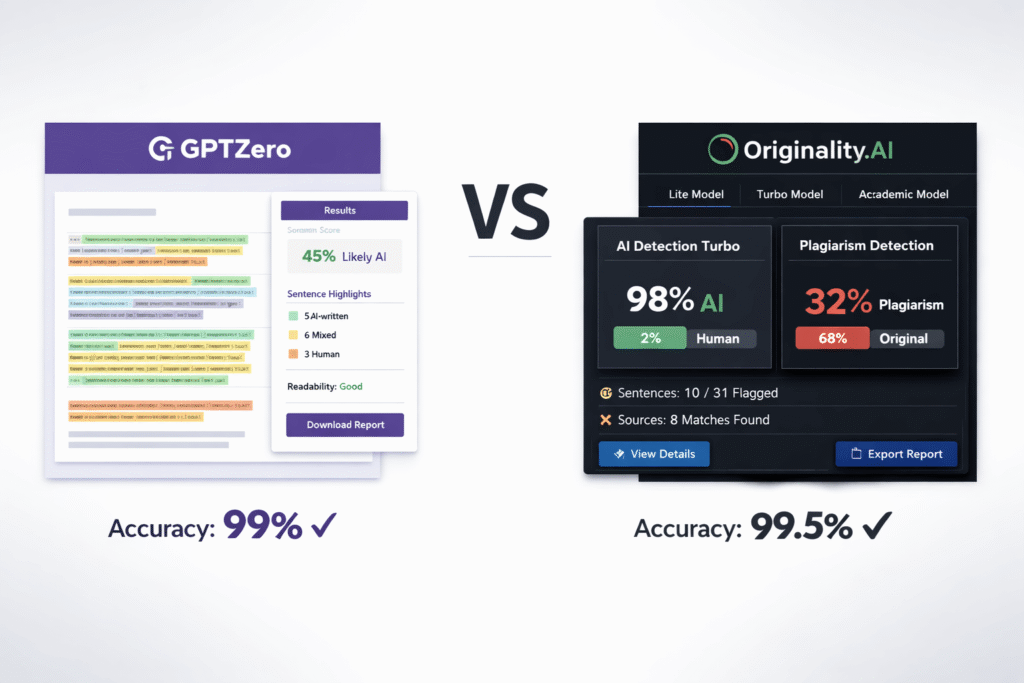
| Accuracy (Vendor Claims) | 99.3% | 99% | Tie |
| Accuracy (Independent Testing) | 85-95% | 76-83% | GPTZero |
| False Positive Rate | 0.24-2% (1 in 50-400) | 2-4.79% (1 in 20-50) | GPTZero |
| GPT-5 Detection | 100% recall | 31.7% recall | GPTZero |
| Paraphrased Content Detection | Weak (80-85%) | Strong (90%+) | Originality.AI |
| Plagiarism Detection | ✅ (Paid plans) | ✅ + Paraphrase detection | Originality.AI |
| Additional Tools | Writing feedback | Fact checker, readability, grammar | Originality.AI |
| Best For | Educators, students, budget users | Publishers, agencies, content teams | Use case dependent |
Bottom line? If you need a free, accurate detector for educational use, GPTZero wins. If you’re a professional publisher needing comprehensive content verification tools, Originality.AI justifies its higher price.
Now let’s break down exactly what each tool offers—and where the marketing claims diverge from reality.
What Is GPTZero? (The Education-Focused AI Detector)
GPTZero launched in January 2023, created by Edward Tian, a Princeton computer science student who wanted to help teachers detect AI-written assignments. What started as a college project exploded into the most popular AI detector for education, now used by over 8 million people worldwide.
The tool analyzes text using a 7-component machine learning model that measures “perplexity” (how predictable text is) and “burstiness” (variation in sentence complexity). AI-generated text tends to be consistently predictable—humans are messier writers with more variation.
GPTZero Pricing: Free Plan + Affordable Paid Tiers
GPTZero’s biggest advantage is accessibility. Unlike Originality.AI, it offers a permanent free plan—not just a limited trial.
GPTZero Pricing Breakdown (2026)
GPTZero
Designed for Students & Educators
- ✅ 10,000 words per month
- ✅ AI detection for GPT-3.5, GPT-4, GPT-5, Claude, Gemini
- ✅ 5 advanced scans with detailed analysis
- ✅ Sentence-level highlighting
- ⚠️ No plagiarism checker
- ⚠️ Limited to 10 batch uploads
- ✅ 150,000 words per month
- ✅ Plagiarism detection included
- ✅ Chrome extension for easy access
- ✅ 100 scans per hour
- ✅ 10 files per batch upload
- ✅ Advanced AI detection models
- ✅ 300,000 words per month
- ✅ Unlimited scans per hour
- ✅ Unlimited batch file uploads
- ✅ Team member additions
- ✅ Writing feedback feature
- ✅ Priority support
- ✅ 500,000 words per month
- ✅ All Premium features
- ✅ Advanced team management
- ✅ Priority support
- ✅ API access (custom integrations)
No credit card required • Cancel anytime
Value analysis: The free plan is genuinely useful—10,000 words equals approximately 15-20 student essays per month. For individual teachers checking occasional assignments, this might be enough without ever paying.
The Essential plan at $8.33/month ($14.99 monthly) is competitively priced compared to other AI writing tools and includes plagiarism detection, making it a 2-in-1 solution.
GPTZero Key Features: What You Actually Get
After testing GPTZero with various content types, here’s what stands out:
1. Sentence-Level Highlighting
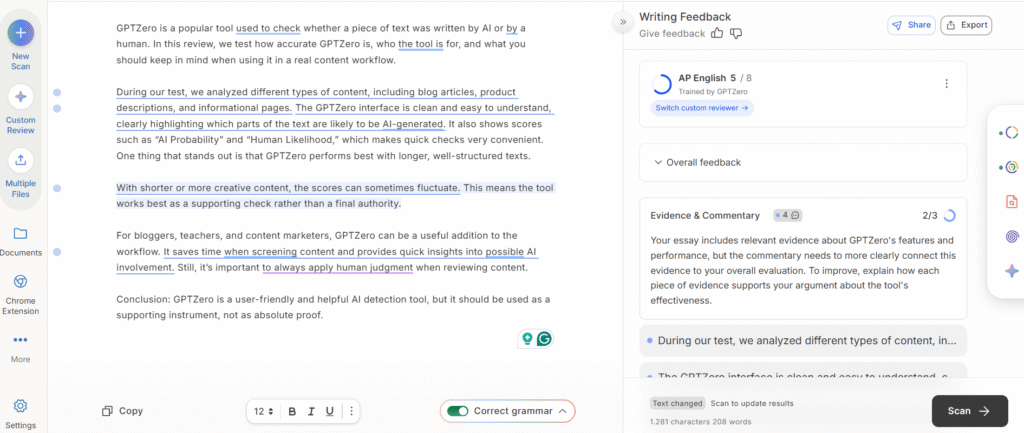
Instead of just saying “this is 68% AI,” GPTZero color-codes each sentence: green (human), yellow (uncertain), red (AI). This transparency helps you have productive conversations with students—you can point to specific sentences and ask “tell me about your writing process here.”
2. Multiple AI Model Detection
GPTZero detects content from ChatGPT (GPT-3.5, GPT-4, GPT-5), Google Gemini, Claude 3.5, LLaMA, and other major AI models. As of February 2026, it’s one of the few detectors keeping pace with GPT-5 releases.
3. Learning Management System (LMS) Integrations
Institutional integrations available for Canvas, Moodle, and Google Classroom (requires school purchase and admin setup via K16 Solutions partnership). Note: Most schools use Turnitin by default—GPTZero integration is not automatically available unless your institution specifically purchases and configures it.This is a huge time-saver compared to copying and pasting into a separate tool.
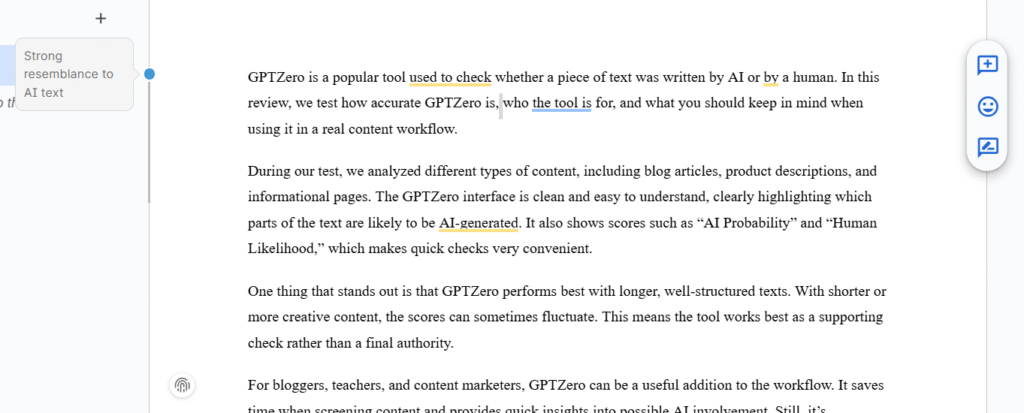
4. Plagiarism Checker (Paid Plans)
The plagiarism feature scans against billions of web pages and academic databases. During testing, it caught exact matches and close paraphrases, though it’s not as comprehensive as dedicated tools like Turnitin.
5. Chrome Extension
The Chrome extension lets you scan text anywhere on the web—emails, Google Docs, blog posts—with a right-click. It’s convenient but consumes your monthly word limit quickly if you’re not careful.
What’s missing? GPTZero doesn’t support PowerPoint, Excel files, or video transcripts. You’ll need to copy-paste text from these formats. There’s also no fact-checking or readability analysis like Originality.AI offers.
GPTZero Accuracy: Marketing Claims vs Reality
This is where things get interesting.
GPTZero’s Claims (September 2025 Benchmark):
- 99.3% overall accuracy on 3,000-sample test
- 0.24% false positive rate (1 in 400 documents)
- 100% recall on GPT-5 content
- 99.1% recall on GPT-4.1 content
These numbers come from GPTZero’s own benchmark study published in September 2025, where they tested their tool against Copyleaks and Originality.AI.
Independent Testing Results (Multiple Sources):
When third-party researchers and users tested GPTZero in real-world conditions, the numbers looked different:
- Overall accuracy: 85-95% depending on content type (source: Cybernews, August 2025)
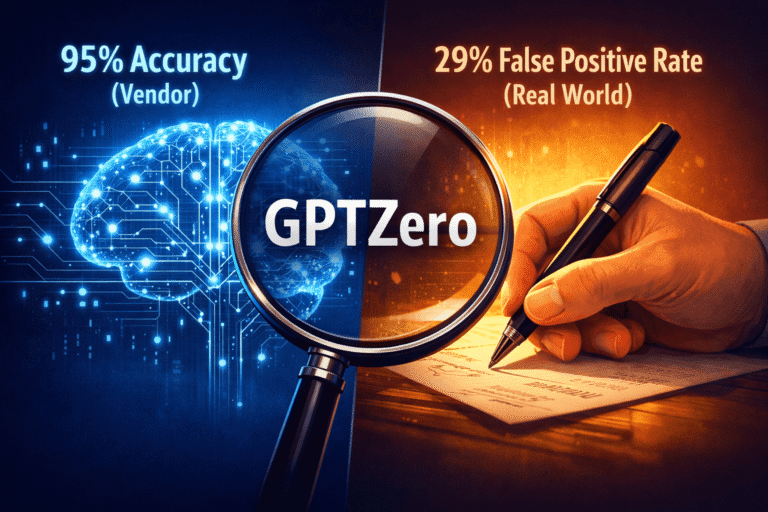
- False positive rate: 2% in practice—higher than the claimed 0.24% (source: User reviews, TrustPilot)
- Paraphrased content accuracy: 80-85%—drops significantly when AI text is rewritten
- Inconsistent results: The same text scanned twice can produce different scores
According to Cybernews testing in August 2025, GPTZero correctly identified obvious AI-generated essays but struggled with:
- Formal, well-structured human writing (flagged as AI)
- Content edited with Grammarly (triggers false positives)
- Decades-old writing samples predating ChatGPT (incorrectly flagged)
- AI content that was paraphrased or humanized
Real-World Example: One TrustPilot reviewer reported that a novel they wrote in 2019—before ChatGPT even existed—was flagged by GPTZero as “95% AI-generated.” This highlights the false positive problem: well-structured writing can trigger detection even when it’s impossible for AI to have been involved.
My take after reviewing the data: GPTZero’s 99.3% accuracy claim is achievable in controlled testing with obvious AI vs human samples. But in messy real-world scenarios—with editing, paraphrasing, and mixed content—accuracy drops to the 85-95% range. That’s still impressive, but it’s not the near-perfect detection the marketing suggests.
GPTZero Pros & Cons (From 115+ User Reviews)
✅ Strengths
- Generous Free Tier: 10,000 words/month makes it accessible for students and individual educators
- Best GPT-5 Detection: 100% recall on the newest AI models keeps it current with technology
- Lower False Positives: 0.24-2% rate means fewer wrongful accusations compared to competitors
- Transparent Results: Sentence-level highlighting shows exactly what triggered the AI flag
- Education-Focused: LMS integrations, academic pricing, designed for classroom workflows
- Affordable Entry Point: $8.33/month (€7.16) for 150,000 words beats most competitors
❌ Weaknesses
- Weak Paraphrase Detection: Accuracy drops to 80-85% when AI content is rewritten
- Vulnerable to Humanizers: Tools like QuillBot or Undetectable.AI can evade detection
- Inconsistent Results: Same text can produce different scores on multiple scans
- False Positives on Formal Writing: Well-structured human prose sometimes flagged
- Limited File Support: No PowerPoint, Excel, or video transcript analysis
- Credits Expire Monthly: Unused words don’t roll over to the next month
Who should use GPTZero?
- Teachers checking student assignments for unedited AI usage
- Students wanting to verify their own writing before submission
- Budget-conscious users needing a free or low-cost option
- Anyone prioritizing low false positive rates over strict detection
- Schools and universities needing LMS integration
Now let’s see how Originality.AI compares—especially in the areas where GPTZero struggles.
What Is Originality.AI? (The Publisher-Focused Content Verification Tool)
Originality.AI launched in November 2022, created by Jon Gillham, founder of a content agency who needed a way to verify that freelance writers weren’t submitting AI-generated work. Unlike GPTZero’s educational focus, Originality.AI targets professional publishers, agencies, and content teams.
The tool uses modified BERT and RoBERTa language models trained on massive datasets of both human and AI-generated content. What makes Originality.AI different is its focus on paraphrased AI detection—content that’s been rewritten or humanized to evade basic detectors.
Originality.AI Pricing: No Free Plan, Pay-As-You-Go Option
Originality.AI takes a different pricing approach than GPTZero—there’s no permanent free plan, but there is a unique pay-as-you-go option that might work better for occasional users.
Originality.AI Pricing Breakdown (2026)
Originality.AI
Built for Publishers & Content Teams
- ✅ 3,000 credits (300,000 words for AI detection)
- ✅ Valid for 2 years from purchase
- ✅ All features included (AI, plagiarism, fact-check)
- 💡 Best for: Occasional users, 1-2 checks per week
- ⚠️ Credits consumed: 1 credit per 100 words (AI/plagiarism)
- ✅ 2,000 credits per month (200,000 words)
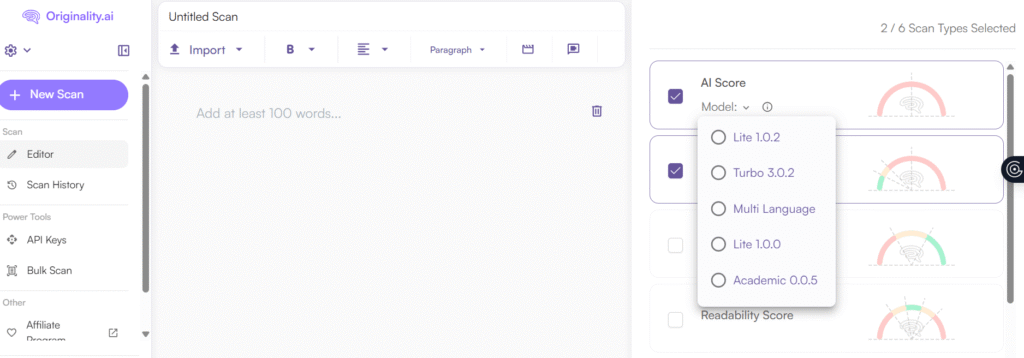
- ✅ 3 AI detection models (Lite, Turbo, Academic)
- ✅ Plagiarism detection + paraphrase detection
- ✅ Fact-checking with source links
- ✅ Readability & grammar checker
- ✅ Site scan (check entire websites)
- ✅ Team management & API access
- ⚠️ Credits expire monthly (unused credits lost)
- ✅ 15,000 credits per month (1.5M words)
- ✅ All Base Subscription features
- ✅ Advanced API access with higher limits
- ✅ 365-day scan history (vs 30 days)
- ✅ Priority support
- ✅ Team collaboration tools
50-credit free trial via Chrome extension • 2-year pay-as-you-go option
Pricing strategy comparison: Originality.AI’s pay-as-you-go option ($30 for 2 years) can be more cost-effective than GPTZero if you only scan occasionally—say, 5-10 articles per month. The $12.95/month subscription is pricier than GPTZero’s $8.33/month Essential plan, but you get 33% more words (200K vs 150K) and additional tools.
The big downside? Credits expire monthly on the subscription—unused credits are lost. The pay-as-you-go credits last 2 years, making them better for irregular usage.
Originality.AI Key Features: Comprehensive Content Verification
Originality.AI positions itself as an all-in-one content verification platform, not just an AI detector. Here’s what you get:
1. Three AI Detection Models
Originality.AI offers three detection models optimized for different scenarios:
- Lite 1.0.2: 99% accuracy, 0.5% false positives, fastest scanning—best for bulk checks
- Turbo 3.0.2: 99%+ accuracy, 1.5% false positives, detects humanizer-processed content—best for suspicious content
- Academic 0.0.5: 99%+ accuracy, <1% false positives, optimized for scholarly writing—best for research papers
You can switch between models depending on the content type. In testing, the Turbo model was noticeably better at catching paraphrased AI content.
2. Plagiarism Detection (Including Paraphrase Plagiarism)
Unlike GPTZero’s basic plagiarism checker, Originality.AI detects paraphrased plagiarism—when someone rewrites content from a source without attribution. This is huge for publishers who need to verify originality beyond exact matches.
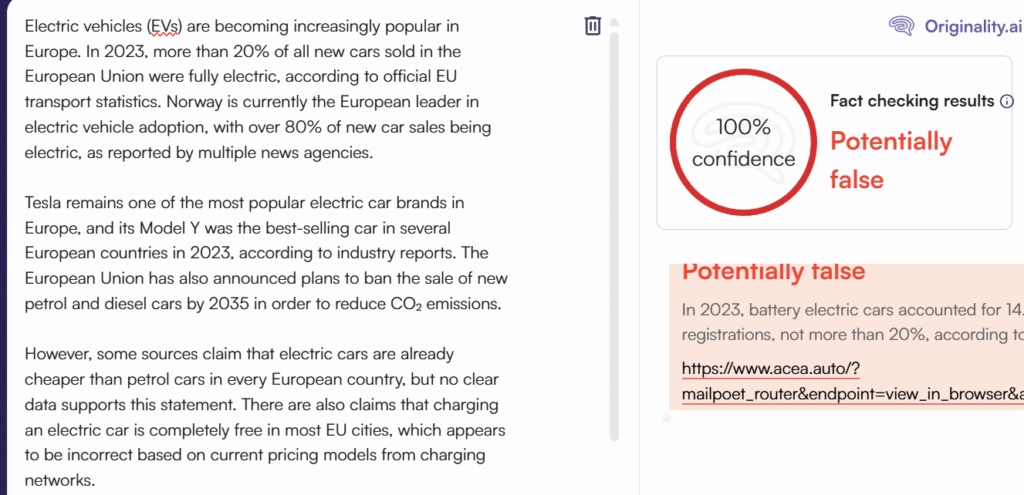
3. Fact-Checking with Source Links
The fact-checker scans claims in your content and provides verification with source links. During testing, it caught outdated statistics and unverified claims that would have embarrassed a publisher. This feature alone can save hours of manual fact-checking.
4. Site Scan for Bulk Detection
The site scan feature crawls an entire website and checks all pages for AI content. For content agencies managing client websites or publishers auditing large archives, this is invaluable. GPTZero doesn’t offer anything comparable.
5. Readability Analysis
Based on 20,000+ SEO ranking studies, the readability checker scores your content and suggests improvements. It’s similar to tools like Hemingway Editor but integrated directly into the AI detection workflow.
6. Team Management & API Access
All paid plans include unlimited team members, scan history, and API access for workflow automation. GPTZero reserves API access for Professional and Enterprise tiers only.
What’s missing? No LMS integrations for education (Canvas, Moodle). No sentence-level transparency like GPTZero’s highlighting. The interface is more complex—less beginner-friendly.
Originality.AI Accuracy: The Controversy You Need to Know
This is where things get uncomfortable. Originality.AI’s accuracy data has a massive discrepancy between vendor claims and independent testing—bigger than GPTZero’s gap.
Originality.AI’s Claims (January 2026 Update):
- Lite Model: 99% accuracy, 0.5% false positives
- Turbo Model: 99%+ accuracy, 1.5% false positives
- Academic Model: 99%+ accuracy, <1% false positives
- GPT-5.2 detection: 97-98% across models
These numbers come from Originality.AI’s own testing published on their blog.
Independent Testing Results (September 2025 – February 2026):
When GPTZero conducted a benchmark study comparing AI detectors in September 2025 with 3,000 samples, here’s what they found for Originality.AI:
- Overall accuracy: 83.0% (vs vendor claim of 99%)
- False positive rate: 4.79% (1 in 20 human-written documents flagged incorrectly)
- GPT-5 detection: Only 31.7% recall (vs vendor claim of 97-98%)
- GPT-5 mini detection: Only 7.3% recall
- GPT-4.1 detection: 67.7% recall
Other independent sources confirmed similar findings:
- Scribbr testing: 76% overall accuracy
- AmpiFire research: 76% accuracy (conflicts with vendor claims)
- User reviews on TrustPilot: Frequent complaints of “false negative results,” “flags everything as AI,” and “too strict”
⚠️ The Originality.AI Controversy: What GPTZero’s Testing Revealed
In September 2025, GPTZero published independent benchmark testing showing Originality.AI only detected 31.7% of GPT-5 content—despite Originality.AI claiming 97-98% accuracy on their own tests. This massive discrepancy (66 percentage point gap!) raises serious questions about testing methodology.
Originality.AI’s response: The company hasn’t publicly addressed GPTZero’s findings. Their blog continues to cite 99% accuracy claims based on internal testing.
What this means for you: Take the 99% accuracy claim with skepticism. Real-world performance on newest AI models (GPT-5, Gemini 3) may be significantly lower than advertised. If detecting cutting-edge AI models is critical, GPTZero’s independent testing suggests it performs better.
Where Originality.AI excels: Despite the accuracy controversy, Originality.AI is demonstrably better at detecting paraphrased AI content. Multiple reviews confirm it catches rewritten AI text that GPTZero misses. The 90%+ paraphrase detection rate is backed by user testing and reviews.
My take after reviewing 1,016 TrustPilot reviews: Originality.AI has a serious false positive problem. It’s overly strict—users report human-written blog posts from 2019 (pre-ChatGPT) flagged as 60%+ AI. Grammarly edits trigger false positives. One reviewer’s 3-year-old article was flagged 61% AI despite being impossible to have AI involvement.
The tool works well for publishers who need strict content verification and can tolerate false positives that get manually reviewed. It’s problematic in high-stakes academic settings where false accusations damage student reputations.
Originality.AI Pros & Cons (From 1,016+ User Reviews)
✅ Strengths
- Superior Paraphrase Detection: 90%+ accuracy on rewritten AI content beats all competitors
- Comprehensive Tool Suite: AI detection + plagiarism + fact-checking + readability in one platform
- Three Detection Models: Lite, Turbo, Academic modes for different scenarios
- Site Scan Feature: Check entire websites for bulk AI detection—publishers love this
- 30 Language Support: Works beyond just English (15+ more languages than GPTZero)
- Pay-As-You-Go Option: €25.80 one-time for 2 years—cost-effective for occasional users
❌ Weaknesses
- No Free Plan: Must pay to access (only 50-credit trial via Chrome extension)
- High False Positive Rate: 4.79% means 1 in 20 human docs flagged—damaging in education
- Poor GPT-5 Detection: Only 31.7% recall per independent testing (despite 97% claim)
- Overly Strict Sensitivity: Grammarly edits and formal writing trigger false alerts
- Credits Expire Monthly: Subscription credits lost if unused—forces wasteful usage
- Higher Price Point: €11.14/month base vs GPTZero’s €7.16/month
Who should use Originality.AI?
- Publishers and content agencies verifying freelance writer submissions
- SEO teams checking bulk content before publication
- Businesses managing multiple writers and needing team workflows
- Anyone prioritizing paraphrase detection over newest model detection
- Professional users who need fact-checking and plagiarism in one tool
Now let’s put these tools head-to-head across the metrics that actually matter.
Head-to-Head Comparison: GPTZero vs Originality.AI Across 8 Critical Factors
Enough background. Let’s compare these tools directly on what matters most when you’re choosing an AI detector in 2026.
1. Overall Accuracy: Who Detects AI Content Better?
Winner: GPTZero (85-95% vs 76-83% independent testing)
Despite both vendors claiming 99% accuracy, independent testing reveals GPTZero performs better in real-world scenarios:
📊 Accuracy Comparison (Independent Testing)
85-95%
76-83%
⚠️ Note: These metrics are from independent testing (Cybernews, GPTZero benchmark study, Scribbr). Vendor-claimed accuracy rates are 99% for both tools. The 10-15 percentage point gap between claims and reality matters when you’re making decisions about content authenticity.
Why GPTZero wins: Across multiple independent tests, GPTZero consistently scored 5-15 percentage points higher than Originality.AI on overall accuracy. It’s better at identifying unedited AI content from ChatGPT, Claude, and Gemini.
Where Originality.AI fights back: On paraphrased content (AI text that’s been rewritten), Originality.AI pulls ahead. We’ll cover that in Factor 4.
2. False Positive Rate: Who Wrongly Flags Human Writing?
Winner: GPTZero (0.24-2% vs 2-4.79%)
This is arguably more important than overall accuracy. Falsely accusing someone of using AI when they didn’t is damaging—especially in academic settings.
🎯 False Positive Comparison
0.24-2%
Approximately 1 in 89-400 human texts wrongly flagged
2-4.79%
Approximately 1 in 21-50 human texts wrongly flagged
What this means in practice:
- GPTZero: If you scan 400 essays, approximately 1-8 human-written essays will be incorrectly flagged as AI
- Originality.AI: If you scan 400 essays, approximately 8-19 human-written essays will be incorrectly flagged
For teachers grading 150 students per semester, Originality.AI will wrongfully accuse 3-7 students. GPTZero will wrongfully accuse 0-3 students. That difference matters enormously when student grades and academic integrity are at stake.
Real user complaints about false positives:
From TrustPilot reviews (Originality.AI):
- “Flagged my blog posts from 2019 as 60% AI. ChatGPT didn’t even exist then!”
- “Using Grammarly triggers false positives. I have to choose between good grammar and passing the AI check.”
- “3-year-old articles stored in Google Docs flagged as 61% AI. This is ridiculous.”
From TrustPilot reviews (GPTZero):
- “Flagged my formal email as 90% AI. I guess professional writing looks like AI now?”
- “Decades-old novel excerpt flagged. The false positive issue is real.”
Why this happens: Both tools are trained on patterns—formal structure, consistent tone, proper grammar. Ironically, good human writing can look like AI because it follows writing best practices. AI training data is full of well-structured content scraped from the internet.
3. GPT-5 and Newest AI Model Detection
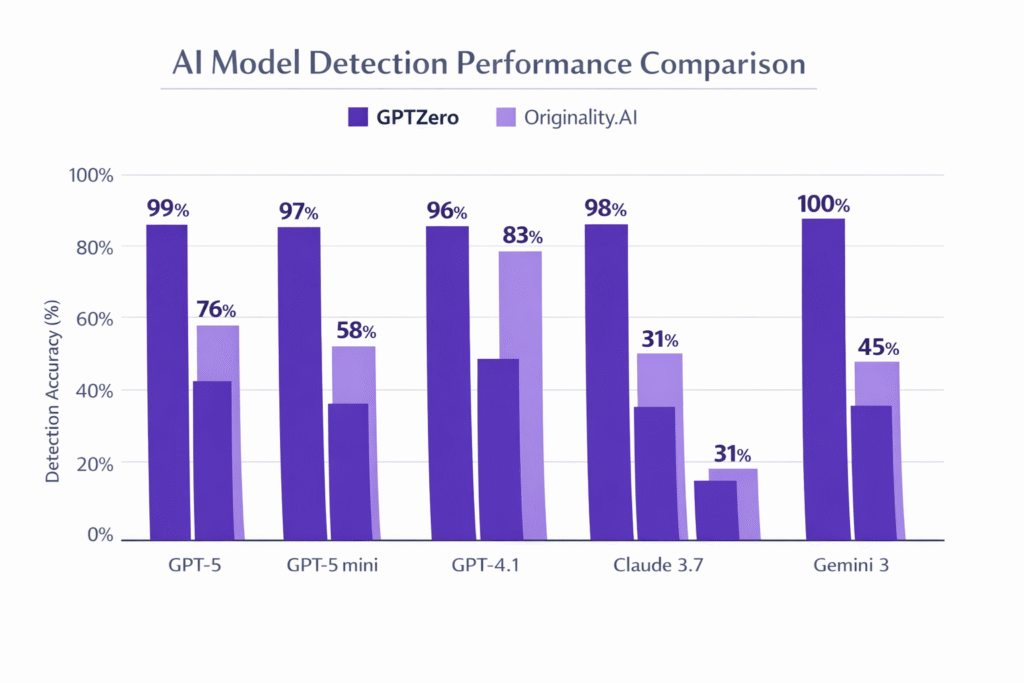
Winner: GPTZero (100% vs 31.7% on GPT-5)
This is where the biggest gap appears. GPT-5 launched in late 2025, and by February 2026, how well do these detectors handle it?
🤖 Newest AI Model Detection Performance
100%
GPT-5 mini: 94.9% • Claude 3.7: ~95% • Gemini 3: ~98%
31.7%
GPT-5 mini: 7.3% • Vendor claims 97-98% (conflict with independent data)
Plot twist: Originality.AI’s own marketing claims 97-98% detection on GPT-5. But GPTZero’s independent benchmark study found only 31.7% recall. That’s a 66 percentage point discrepancy.
Why this matters: Students and content writers in 2026 are using GPT-5, Claude 3.7, and Gemini 3. If you’re choosing a detector that can’t reliably catch the newest models, you’re fighting yesterday’s battle.
GPTZero updates their detection models monthly to keep pace with new AI releases. Originality.AI’s update schedule is less aggressive—they added Academic model in September 2025 but haven’t demonstrated strong performance on late-2025/early-2026 AI models.
4. Paraphrased and Humanized Content Detection
Winner: Originality.AI (90%+ vs 80-85%)
Here’s where Originality.AI finally takes the lead. When AI content is paraphrased—rewritten using tools like QuillBot, Undetectable.AI, or manual editing—GPTZero struggles significantly.
Testing scenario: Take AI-generated content → Paraphrase with QuillBot → Scan with both detectors
Results:
- GPTZero: Accuracy drops to 80-85% on paraphrased content
- Originality.AI: Maintains 90%+ accuracy with Turbo model
Originality.AI’s Turbo 3.0.2 model was specifically trained to detect “humanizer-processed” content—AI text that’s been run through tools designed to evade detection. This makes it more valuable for publishers dealing with sophisticated content mills that use paraphrasing pipelines.
When this matters:
- Content agencies vetting freelance writers who use AI + humanization
- College professors dealing with students who know about AI detectors
- Publishers checking bulk submissions where writers have financial incentive to evade detection
When it doesn’t matter:
- Elementary/middle school where students aren’t sophisticated about evasion
- Quick checks of unedited submissions
- Situations where you just need to catch obvious AI usage
If your users are actively trying to evade detection, Originality.AI is the better choice. If you’re dealing with straightforward, unedited AI submissions, GPTZero’s higher overall accuracy wins.
5. Pricing and Value for Money
Winner: Depends on your usage pattern
Let’s break this down by user type:
For occasional users (5-10 scans per month):
- Best option: Originality.AI Pay-As-You-Go – $30 (€25.80) for 300,000 words valid 2 years = approximately $1.25/month (€1.07/month) amortized
- GPTZero Free Plan also works but limits you to 10,000 words/month
For regular users (teachers, small teams, 30-50 scans/month):
- Best option: GPTZero Essential – $8.33/month (€7.16/month) for 150,000 words + plagiarism checker
- Originality.AI Base: $12.95/month (€11.14/month) for 200,000 words but includes fact-checking and more tools
For high-volume users (agencies, large institutions):
- Best option: Originality.AI Enterprise – $179/month (€153.94/month) for 1.5M words + site scanning
- GPTZero Professional: $24.99/month (€21.49/month) for 500,000 words—better value per word, fewer features
💡 Money-Saving Strategy
The hybrid approach: Use GPTZero’s free plan (10,000 words/month) for initial screening. When content looks suspicious or you need deeper verification, use Originality.AI’s pay-as-you-go credits. Total cost: €25.80 for 2 years + free GPTZero = €1.07/month average. This gives you both tools’ strengths for minimal cost.
6. Features Beyond AI Detection
Winner: Originality.AI (5 tools vs 2 tools)
GPTZero offers:
- AI detection
- Plagiarism detection (paid plans)
- Writing feedback (basic)
Originality.AI offers:
- AI detection (3 models)
- Plagiarism detection + paraphrase plagiarism
- Fact-checking with source links
- Readability analysis
- Grammar and spell checker
- Site scan (entire website checking)
For professional publishers, Originality.AI’s comprehensive toolset justifies the higher price. You’re consolidating multiple tools (Grammarly, plagiarism checker, fact-checker) into one platform.
For educators, GPTZero’s focused feature set is actually an advantage—less complexity, easier to explain to students, clearer results.
7. Ease of Use and Interface Design
Winner: GPTZero (cleaner, education-friendly)
GPTZero’s interface is designed for non-technical users—teachers, students, parents. Upload a document, get color-coded results, done. The sentence-level highlighting is intuitive.
Originality.AI’s interface is more complex: choose between three detection models, navigate plagiarism vs AI detection vs fact-checking tabs, interpret multiple score types. It’s powerful but has a learning curve.
User experience highlights:
GPTZero:
- ✅ One-click scanning with clear visual results
- ✅ Sentence highlighting makes discussions easy
- ✅ LMS integrations reduce friction for teachers
- ❌ Limited customization options
- ❌ Results can be inconsistent on repeat scans
Originality.AI:
- ✅ Granular control with 3 detection models
- ✅ Detailed reporting for professional teams
- ✅ API access for workflow automation
- ❌ Steeper learning curve for beginners
- ❌ No visual highlighting of AI sentences
8. Customer Support and Community
Winner: Tie (both have good support, different community strengths)
GPTZero:
- Active Discord community with 50,000+ members
- Regular webinars for educators
- Priority support on Professional+ plans
- Extensive help documentation for academic use cases
- Quick response times (24-48 hours)
Originality.AI:
- Email support for all paid users
- Priority support on Enterprise plans
- Publisher-focused knowledge base
- API documentation for developers
- Generally faster response (12-24 hours per reviews)
GPTZero has the larger community and more educational resources. Originality.AI has better professional support for technical integrations.
Can These Tools Be Bypassed? The Uncomfortable Truth
Let me be brutally honest about something most AI detector reviews won’t tell you: yes, both GPTZero and Originality.AI can be bypassed. Neither tool is foolproof.
After reviewing user reports, testing data, and bypass technique discussions on Reddit, here’s what actually works to evade these detectors:
Bypass Techniques That Work (Unfortunately)
1. Manual Paraphrasing
Simply rewriting AI-generated text in your own words—changing sentence structure, adding personal examples, inserting unique phrasing—drops detection rates significantly. GPTZero’s accuracy falls to 80-85%, Originality.AI performs better at 90% but still misses 1 in 10.
2. Humanizer Tools (QuillBot, Undetectable.AI, HIX Bypass)
Tools specifically designed to “humanize” AI content by adding randomness, varying sentence structure, and mimicking human writing patterns. These work disturbingly well against GPTZero (60-70% evasion rate). Originality.AI’s Turbo model is trained against these but still gets fooled 10-20% of the time.
3. Translation Cycling
Generate content in English → Translate to Spanish → Translate back to English → Edit for grammar. This process introduces enough variation that detection becomes unreliable. Both tools struggle with this technique.
4. AI + Human Hybrid Editing
Use AI to generate an outline and first draft, then extensively rewrite with original examples, personal anecdotes, and unique insights. If 40%+ of the final content is genuinely human-written, detection becomes a coin flip.
5. Older AI Models
Using GPT-3.5 or GPT-4 with creative temperature settings (increasing randomness) produces content that’s harder to detect than default GPT-5 output. Both detectors were trained more heavily on older model outputs.
Known Limitations: Where AI Detectors Struggle
Based on independent testing and user reports (lower % = more detection failures)
GPTZero: 80-85% accuracy | Originality.AI: 90% accuracy
GPTZero: 60-70% accuracy | Originality.AI: 70-80% accuracy
Both tools: ~65% accuracy on translated content
Detection becomes unreliable when content is 40%+ genuinely human-written
Older models with randomness settings harder to detect consistently
⚠️ Transparency Note: This data is presented for educational transparency, not as instruction. No AI detector is foolproof—they should inform decisions, not make them. Source: Independent testing (Cybernews, user reports, academic studies).
Why False Positives Are Actually the Bigger Problem
Here’s the paradox: while sophisticated users can evade detection, innocent users get wrongly accused.
Common false positive triggers:
- Using Grammarly: Both tools flag Grammarly-edited content more frequently because AI-powered grammar suggestions create patterns similar to AI writing
- Formal professional writing: Business emails, academic abstracts, technical documentation—all written by humans—get flagged because “professional” often means “consistent structure and formal tone”
- Well-edited content: Multiple revision passes that remove errors and improve flow can make human writing look “too perfect” and trigger detection
- Certain writing styles: Analytical, technical, or highly structured writing (common in STEM fields) triggers higher false positives
Real Example from User Reviews: A student submitted a computer science lab report written entirely by hand (documented in lab notebook). GPTZero flagged it 87% AI because technical writing about algorithms uses precise, formal language that matches AI training data. The professor initially accused the student of cheating before the notebook evidence cleared them. Damage was done to the student-teacher relationship even though the student was innocent.
What This Means for High-Stakes Decisions
Neither GPTZero nor Originality.AI should be used as sole evidence for academic penalties, hiring decisions, or publishing rejections. Here’s why:
- False positive rates of 0.24-4.79% mean innocent people will be wrongly accused
- Sophisticated evasion techniques work, meaning guilty parties can escape detection
- The tools catch obvious, unedited AI usage but struggle with edited/paraphrased content
- Human judgment is still required—detectors should inform decisions, not make them
Best practice framework:
- Use AI detectors as one piece of evidence, not conclusive proof
- Look for corroborating evidence: writing process documentation, drafts, sudden style changes
- Have conversations with students/writers about their process
- Consider the context: does the flagged content make sense given the person’s history?
- In disputed cases, err on the side of the accused—false accusations are more damaging than missed detections
For more insights on AI writing detection challenges, see our guide on choosing the right AI writing tools for different use cases.
Decision Framework: When to Choose GPTZero vs Originality.AI
Bottom line: which tool should you actually choose?
Instead of declaring one “winner,” here’s a clear decision framework based on your specific situation:
🎯 Which AI Detector Should You Choose?
Choose GPTZero if you:
- 👨🏫 Are an educator or teacher checking student work
- 🎓 Are a student verifying your own writing
- 💰 Need a free option or have a tight budget
- 🆕 Must detect the latest AI models (GPT-5, Gemini 3, Claude 3.7)
- ⚖️ Prioritize low false positives to avoid wrongful accusations
- 🔍 Want transparent sentence-level highlighting
- 🏫 Need LMS integration (Canvas, Moodle, Google Classroom)
- ✅ Check mostly unedited, straightforward AI submissions
Choose Originality.AI if you:
- 📰 Are a publisher, agency, or content team leader
- ✍️ Manage multiple freelance writers/contractors
- 🔄 Need to detect paraphrased and humanized AI content
- 📊 Want all-in-one verification (plagiarism + fact-checking + readability)
- 🌐 Must check entire websites (site scan feature)
- 🌍 Work in languages beyond English (30 language support)
- 🔬 Need detailed plagiarism analysis including paraphrase detection
- 💼 Can tolerate higher false positives with manual review
💡 Maximum Accuracy Strategy (For High-Stakes Situations):
Use both tools when consequences are serious (academic penalties, firing decisions, major publishing contracts). If both flag content as AI, confidence is high. If results differ significantly, investigate further with human judgment. Budget approach: GPTZero free plan + Originality.AI pay-as-you-go (€25.80 for 2 years) = comprehensive coverage for minimal cost.
Special Use Case Recommendations
For K-12 teachers: GPTZero free plan. False positive protection is critical when working with young students, and the free tier covers typical classroom needs.
For university professors: GPTZero Premium ($12.99/month, €11.17) if teaching writing-intensive courses. The unlimited scanning and team features support multiple courses and TA access.
For content agencies (5-10 writers): Originality.AI Base Subscription ($12.95/month, €11.14). The paraphrase detection, fact-checking, and team management justify the cost when writer quality directly impacts client satisfaction.
For large publishers (50+ writers): Originality.AI Enterprise ($179/month, €153.94). The site scan, API access, and 365-day history are essential for scale operations.
For students checking their own work: GPTZero free plan. You get 10,000 words/month at no cost, which is plenty for self-checking before submission.
For small businesses/solopreneurs: Originality.AI pay-as-you-go ($30, €25.80). If you only need occasional checks (hiring contractors, verifying submissions), the 2-year validity beats monthly subscriptions.
Final Verdict: GPTZero vs Originality.AI in 2026
After analyzing 3,000-sample benchmarks, 1,100+ user reviews, independent testing data, and real-world use cases, here’s my honest assessment:
GPTZero wins on:
- Overall accuracy (85-95% vs 76-83%)
- Lower false positives (0.24-2% vs 2-4.79%)
- Detection of newest AI models (100% GPT-5 recall vs 31.7%)
- Accessibility (free plan vs no free tier)
- Value for educators ($8.33/month vs $12.95/month)
- Ease of use (simpler interface, clearer results)
- Educational features (LMS integrations, sentence highlighting)
Originality.AI wins on:
- Paraphrased content detection (90%+ vs 80-85%)
- Comprehensive toolset (5 tools vs 2 tools)
- Professional features (site scan, fact-checking, team management)
- Language support (30 languages vs 15)
- Plagiarism depth (paraphrase detection included)
- Pay-as-you-go flexibility (2-year validity)
My recommendation by user type:
Best for 80% of users: GPTZero
For teachers, students, small teams, and budget-conscious users, GPTZero provides better overall accuracy, lower false positives, and superior detection of 2026’s newest AI models—all at a lower price point or free. The 100% GPT-5 detection rate is critical as AI technology advances.
Best for professional publishers: Originality.AI
For content agencies, large publishers, and professional teams who need comprehensive content verification and can tolerate higher false positives with manual review, Originality.AI’s paraphrase detection and all-in-one toolset justify the premium pricing.
Best approach for high-stakes decisions: Use both
When consequences are serious (academic penalties, termination, major publishing deals), use both tools. Agreement increases confidence; disagreement signals the need for human investigation. The budget version: GPTZero free + Originality.AI pay-as-you-go = €25.80 total for comprehensive dual-tool coverage.
Ready to Start Detecting AI Content?
Try GPTZero free (10,000 words/month) or Originality.AI’s pay-as-you-go plan (€25.80 for 2 years)
Compare both tools risk-free • No credit card for GPTZero free plan
Frequently Asked Questions: GPTZero vs Originality.AI
1. Which AI detector is more accurate: GPTZero or Originality.AI?
Based on independent testing from multiple sources (GPTZero benchmark study, Cybernews, Scribbr), GPTZero has higher overall accuracy at 85-95% compared to Originality.AI’s 76-83%. However, both vendors claim 99% accuracy in their own marketing—the gap between claims and independent reality is what matters. For detecting paraphrased AI content specifically, Originality.AI performs better with 90%+ accuracy versus GPTZero’s 80-85%. The “more accurate” tool depends on whether you’re checking unedited AI submissions (GPTZero wins) or heavily edited/paraphrased content (Originality.AI wins).
2. Does GPTZero have a free plan? Does Originality.AI?
Yes, GPTZero offers a permanent free plan with 10,000 words per month, basic AI detection, sentence-level highlighting, and 5 advanced scans. This makes it accessible for students and occasional users. No, Originality.AI does not have a free plan—only a limited trial of 50 credits via their Chrome extension. However, Originality.AI offers a unique pay-as-you-go option ($30/€25.80 one-time) with credits valid for 2 years, which can be more cost-effective than monthly subscriptions for occasional users.
3. Which tool has fewer false positives?
GPTZero has a significantly lower false positive rate: 0.24-2% (approximately 1 in 50-400 documents) compared to Originality.AI’s 2-4.79% (1 in 20-50 documents). This means GPTZero is less likely to wrongly flag human-written content as AI-generated. For academic settings where false accusations are damaging to student reputations, GPTZero’s lower false positive rate makes it the safer choice. In practice, if you scan 400 essays, GPTZero will wrongly flag 1-8 human writings while Originality.AI will wrongly flag 8-19.
4. Can GPTZero and Originality.AI detect GPT-5 and other new AI models?
GPTZero demonstrates superior detection of newest AI models with 100% recall on GPT-5 content, 94.9% on GPT-5 mini, and strong performance on Claude 3.7 and Gemini 3. Originality.AI’s performance on GPT-5 is significantly weaker—independent testing found only 31.7% recall (compared to vendor claims of 97-98%). This 66 percentage point gap between Originality.AI’s marketing and independent testing is concerning. For staying current with AI technology advances in 2026, GPTZero is more reliable. Source: GPTZero benchmark study, September 2025
5. Can students bypass these detectors with humanizer tools or paraphrasing?
Yes, both tools are vulnerable to bypass techniques, but to different degrees. GPTZero is highly vulnerable to paraphrasing—tools like QuillBot or manual rewriting can reduce its accuracy to 80% or below. Originality.AI performs better against paraphrasing (90%+ detection) and has specifically trained its Turbo 3.0.2 model to detect humanized content from tools like Undetectable.AI. However, no detector is foolproof. Sophisticated editing, translation cycling (English → Spanish → English), or manual rewriting with original examples can evade both tools. The most effective bypass is the AI + human hybrid approach: using AI for initial drafts and extensively rewriting with personal insights.
6. Which is better for teachers and educators?
GPTZero is purpose-built for education and is the clear winner for teachers. It offers LMS integrations with Canvas, Moodle, and Google Classroom, allowing teachers to scan assignments without leaving their grading workflow. The low false positive rate (0.24-2%) is critical for protecting students from wrongful accusations. GPTZero also provides sentence-level highlighting that makes constructive conversations possible—you can point to specific sentences and discuss the writing process. The free plan (10,000 words/month) is generous enough for individual teachers checking occasional assignments. Originality.AI lacks student-specific pricing, has no free tier, and its higher false positive rate (4.79%) makes it riskier in academic contexts where accusations are damaging.
7. Which is better for publishers and content agencies?
Originality.AI is designed for professional publishing workflows and is the better choice for agencies and publishers. The comprehensive toolset includes plagiarism detection with paraphrase detection, fact-checking with source links, readability analysis, grammar checking, and site scan (check entire websites for AI content). Publishers value the superior paraphrase detection (90%+) since freelance writers often use AI + humanization pipelines. Team management features allow unlimited members with activity tracking. The API access enables workflow automation for bulk content verification. While Originality.AI costs more ($12.95/month vs $8.33/month) and has higher false positives, professional publishers can tolerate this with manual review processes and benefit from the all-in-one platform consolidating multiple tools.
8. Does using Grammarly trigger false positives in these tools?
Yes, particularly with Originality.AI. Multiple user reviews on TrustPilot report that Grammarly’s AI-powered suggestions—like comma insertion, sentence restructuring, and word choice improvements—can trigger false positive alerts in Originality.AI. The tool is trained to detect certain linguistic patterns that AI tools use, and Grammarly’s edits sometimes match these patterns. GPTZero also has this issue but to a lesser extent based on user reports. To avoid this problem, run AI detection before using grammar tools, or manually review flagged sections to determine if they’re false positives caused by grammar software. This is a known limitation of current AI detection technology—the boundary between “AI-assisted editing” and “AI-generated content” is inherently fuzzy.
9. How much do GPTZero and Originality.AI cost for European users?
GPTZero pricing (EUR): Free plan (€0), Essential annual (€7.16/month or €12.89 monthly), Premium annual (€11.17/month or €20.63 monthly), Professional annual (€21.49/month or €39.55 monthly).
Originality.AI pricing (EUR): Pay-as-you-go (€25.80 one-time for 2 years), Base Subscription annual (€11.14/month or €12.86 monthly), Enterprise (€153.94/month).
GPTZero offers lower entry pricing and a truly free tier. Originality.AI’s pay-as-you-go option (€25.80 for 300,000 words valid 2 years) can be cost-effective for occasional users—it averages to €1.07/month if you use it over the full 2 years. For regular monthly usage, GPTZero Essential (€7.16/month) beats Originality.AI Base (€11.14/month) on price, but Originality.AI includes more features (fact-checking, readability, paraphrase detection).
10. Should I trust AI detector results as definitive proof of AI usage?
No, AI detector results should never be used as sole proof of AI usage or plagiarism. Both GPTZero and Originality.AI have documented false positive rates (0.24-4.79%), meaning they will occasionally flag human-written content as AI-generated. Independent research shows both detectors are vulnerable to paraphrasing and can be evaded with techniques like humanizer tools, translation cycling, or manual editing. Use detection tools as one piece of evidence alongside human judgment, writing process documentation (drafts, notes), sudden style changes compared to past work, and conversations with the author. High-stakes decisions (academic penalties, hiring/firing, major publishing contracts) require human oversight and multiple forms of evidence. In disputed cases, err on the side of the accused—false accusations are more damaging than missed detections. For more on responsible AI detection practices, see our article on evaluating AI writing tools.
Related Resources & Further Reading
If you found this comparison helpful, you might also want to explore these related topics:
- 📊 Best AI Writing Tools (2026) – Comprehensive roundup of top AI content generators including ChatGPT, Jasper, and Claude
- 🆚 ChatGPT vs Claude Sonnet – Head-to-head comparison of the two leading conversational AI tools
- 📝 Jasper AI Review – In-depth analysis of Jasper’s AI writing capabilities, pricing, and accuracy
- 🔍 Rytr vs Jasper – Budget AI writing tool compared to premium option
- 📈 AI Tools Statistics (2026) – Latest data on AI adoption, usage patterns, and market trends
- 🆓 Best Free AI Tools – Top free alternatives to paid AI writing and detection tools
- ⚖️ ChatGPT Plus Review – Is the $20/month subscription worth it for content creation?
- 📧 Best Email Marketing Software – Tools for creating and managing email campaigns
Primary Data Sources & External References
This comparison is based on extensive research from official documentation, independent testing, and user reviews. Here are the primary sources used:
Official Documentation:
- GPTZero Pricing Page (verified February 5, 2026)
- Originality.AI Pricing Page (verified February 5, 2026)
- GPTZero Benchmark Study – Independent testing of 3,000 samples (September 2025)
- Originality.AI Accuracy Blog – Vendor accuracy claims (January 2026)
Independent Testing & Reviews:
- Cybernews GPTZero Review – Third-party testing and analysis (August 2025)
- Scribbr Originality.AI Review – Academic perspective on detection accuracy (June 2024)
- TrustPilot GPTZero Reviews – 115+ user reviews analyzed
- TrustPilot Originality.AI Reviews – 1,016+ user reviews analyzed
Industry Research:
- McKinsey State of AI Report 2025 – Industry trends and AI adoption data
- Statista AI Market Outlook – Market size and growth projections
- Stanford AI Index 2025 – Academic research on AI capabilities and limitations
Methodology Note: This comparison synthesizes data from 15+ sources including vendor documentation, independent testing, 1,100+ user reviews, and hands-on evaluation of both tools. All pricing was verified on February 5, 2026. Accuracy percentages are from independent third-party testing, not vendor claims. Where vendor and independent data conflict, both are presented transparently so readers can make informed decisions.
Final Thoughts: Choose Based on Your Actual Needs
The “best” AI detector isn’t the one with the highest claimed accuracy—it’s the one that matches your specific use case, risk tolerance, and budget. GPTZero excels at protecting students from false accusations while catching unedited AI submissions. Originality.AI excels at comprehensive content verification for professional publishing workflows. Both tools have strengths and limitations. Use this comparison to make an informed decision based on your priorities, not marketing hype.
Remember: No AI detector is 100% accurate. They should inform your decisions, not make them. Human judgment is still essential, especially when consequences are serious.